

What Determines Whether a Motorcycle Tank Dent Can Be Removed?
Motorcycle tank dents vary in size, depth, location, and severity. Whether a dent can be repaired depends on the tank’s condition, paint quality, construction, and whether the metal has been stretched or sharply creased. In professional motorcycle dent repair, the goal is to restore the gas tank while preserving its original paint whenever possible. This is where paintless dent repair becomes valuable, as it can remove dents without using body filler, sanding, or repainting.
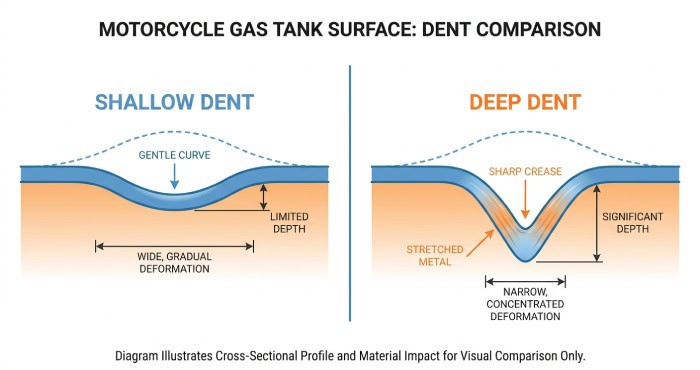
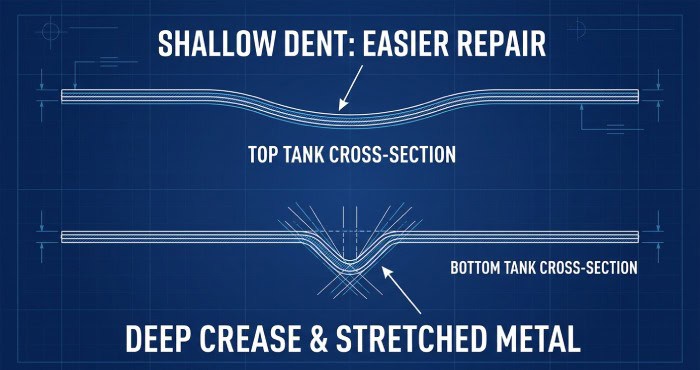
When considering Motorcycle Dent Repair, the main question is whether a specific gas tank dent can be removed without causing additional damage. A shallow dent is generally easier to repair than a deep crease, while older motorcycle tanks may require a more careful approach to preserve their original finish and structure.
Dent Size, Depth, and Location on the Motorcycle Tank
The first factor in dent removal is the physical size and depth of the damage. A small dent in the upper crown of a motorcycle gas tank may be an excellent candidate for paintless dent repair, especially if the original paint is flexible and intact. A shallow dent usually has less metal stressing, which makes it easier to massage the panel back into shape.
By contrast, a large gas tank dent with a hard impact point may not simply “pop” back. Many DIY dent repair videos on YouTube show people trying to pop out dents with suction cups, hot glue pullers, compressed air, or improvised pressure tools. Sometimes these repair kits can help with a minor fuel tank dent, but they can also make a dented tank worse if the metal is stretched or the pull is uneven.
Why Location Matters
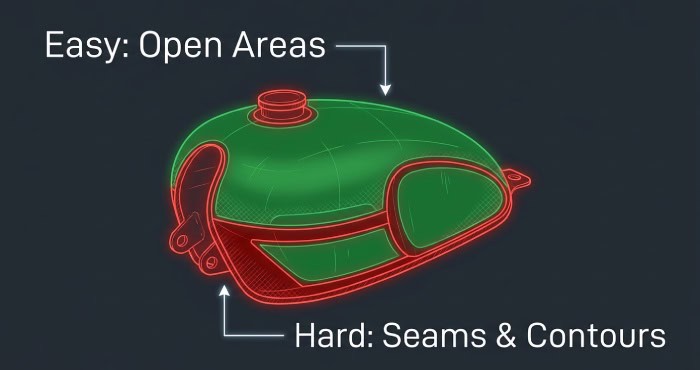
Dent location is just as important as dent size. A dent on a broad, open area of a motorcycle gas tank is often easier to access and shape, whether caused by an impact or hail damage. A dent near a seam, filler neck, badge mount, tunnel, petcock area, balance tube, or sharp bodyline is harder to repair.
Common Easier Dent Locations
A small dent on the top shoulder of the tank may respond well to professional dent removal because the metal has room to move. In some cases, technicians can use specialized tools for dent repair through the body filler opening or underside access points to carefully repair dents from behind.
Common Difficult Dent Locations
Dents near the lower tunnel, welded seams, or mounting tabs are more difficult. On tanks with complex shapes, like certain Harley Davidson models or a Street Glide tank, the contours can limit tool movement. Older Honda examples, including a Super Hawk gas tank or CB450 tank, may have internal baffles that complicate access behind the dent.
Paint Condition and Whether Paintless Dent Repair Is Possible
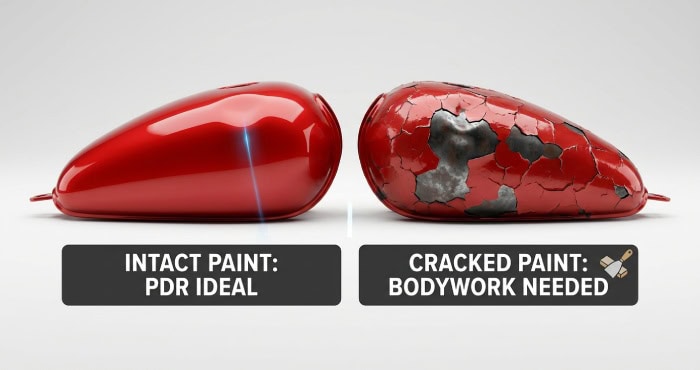
The condition of the paint often determines whether paintless dent repair is realistic. If the original paint is intact, not cracked, and still bonded well to the metal, a skilled technician may be able to remove dents while preserving the finish. For collectible motorcycles, graphics preservation and the ability to save original paint can be more important than making the tank look perfect under fresh paint.
Paintless dent repair is ideal when the paint has not split at the impact point. It is also preferable when the tank has factory decals, pinstripes, airbrushing, or rare vintage motorcycle graphics. A dented motorcycle with original paint may have more value after careful dent removal than after repainting, even if a slight imperfection remains.
When Paint Damage Changes the Plan
If the paint is cracked or peeling, paintless dent repair may cause further damage. Conventional bodywork involving dent repair, minimal Bondo, priming, sanding, and repainting may be necessary. Excessive Bondo should be avoided because it can hide metal damage and lead to future problems.
Original Paint Versus Repainted Tanks
Original paint behaves differently from repainted surfaces. Factory finishes are often tougher and more consistent, while older repaints may crack during dent removal. If you are working on an old tank, a practice tank, or a restored Honda tank, test areas matter. A DIY dent repair attempt should always consider whether the paint is worth saving before trying to pop out dents.
Tank Material, Shape, and Access Behind the Dent
Most traditional motorcycle gas tank shells are steel, which can often be worked with professional motorcycle dent repair tools. Some tanks, however, may have aluminum panels, liners, internal coatings, or complex internal structures. The material affects how the metal moves and how much pressure is safe.
Access is another major limitation. To repair dents from behind, the technician must be able to reach the damaged area with the right tool angle. Gas tank removal may be required, and modern bikes may involve a quick disconnect, fuel pump assembly, vent hoses, wiring, and emissions fittings. A leaky gas tank must be handled before cosmetic dent removal is considered.
Damage Severity: Creases, Stretched Metal, and Sharp Edges
The most difficult dents are not always the largest; they are often the sharpest. Deep creases, hard edges, and impact points concentrate force into a narrow line. Crease removal requires controlled pressure along the damaged line, not just one strong pull. Trying to pop out dents with force alone may leave a ridge or “oil can” effect.
Metal stretching is another major concern. When a gas tank dent has stretched the steel, the panel may not return perfectly to its original contour. Professional motorcycle dent repair involves reading the reflection, reducing crowns, and slowly moving the low area back into position. This is why paintless dent repair is a craft rather than a simple trick.
Signs a Dent May Be Too Severe for PDR Alone
A dent may require refinishing if there are sharp tears, cracked paint, damaged seams, rust, or previous thick bondo. A tank that has already been repaired multiple times may hide filler, rust repair, soldering tank work, or old collision damage beneath the finish.
Severe Damage Indicators
If the motorcycle gas tank has a crease across a bodyline, a crushed corner, or a dent near a welded seam, expect a more complex repair. A dented motorcycle that also has a leaky gas tank should be inspected for structural and fuel safety issues before anyone attempts cosmetic dent removal.
About The Author