
Why Body Lines Make Some Car Dents More Challenging to Repair
What Body Lines Are and Why Automakers Use Them
Body lines are the intentional creases, ridges, contours, and character lines stamped into vehicle body panels during manufacturing. Automakers use them for styling, aerodynamics, structural rigidity, and brand identity. A sharp crease running through a door, a raised crown on a fender, or a sculpted edge on a quarter panel gives the vehicle its shape and visual tension.
These lines are not just cosmetic. They help strengthen thin sheet metal and guide how light reflects across automotive paint. That is why even small door dings on a body line can look more severe than similar dings and dents on a flat panel. The surrounding reflections become distorted, making the damage easier to see from multiple angles.
For modern car reconditioning, body lines matter because they affect every stage of dent repair, dent removal, and paintless dent repair. A technician is not simply “popping out” a dent; they are restoring the original contour of vehicle body panels while preserving factory paint and OEM standards.
Body Lines Are Built Into the Panel’s Memory
When vehicle body panels are stamped at the factory, the metal is stretched and shaped into a specific form. The body line becomes part of the panel’s “memory.” When damage occurs directly on that line, the impact disrupts both the visible surface and the underlying metal tension.
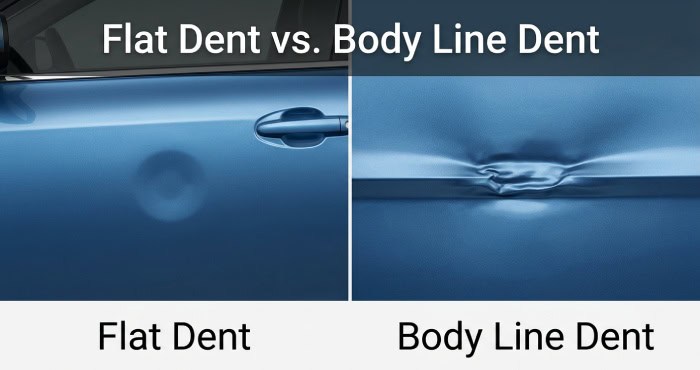
This is why a dent on a flat door skin may be a straightforward PDR job, while the same impact on a crease may require advanced panel reshaping, specialized tools, and more time from trained technicians.
How Dents on Body Lines Affect Metal Tension and Panel Shape
Dents on body lines are challenging because the metal can fold, pinch, or stretch from impacts. The PDR process requires precise work to restore the panel’s height, sharp lines, and smooth reflection without damaging the automotive paint.
Tension, Crowns, and Low Spots
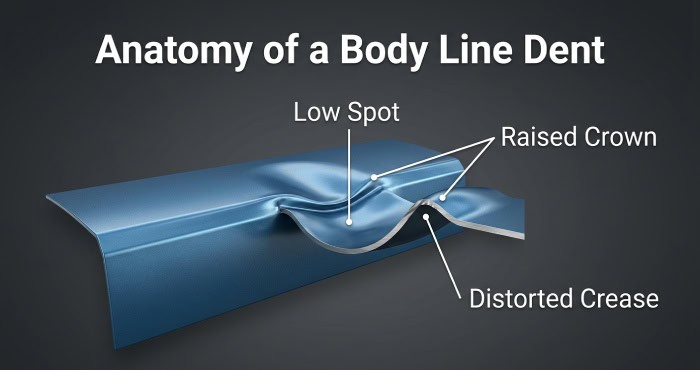
A dented body line usually creates more than one visible defect. There may be:
- A low spot where the impact occurred
- A raised crown around the damaged area
- A distorted crease that no longer matches the original panel shape
- Stress in the automotive paint or clear coat
If dented panels are not repaired correctly, the result may look wavy in sunlight even if the main dent appears reduced. This is why high-quality dent repair emphasizes reflection accuracy, not just making the dent “less noticeable.”
Why Reflection Matters on Body Lines
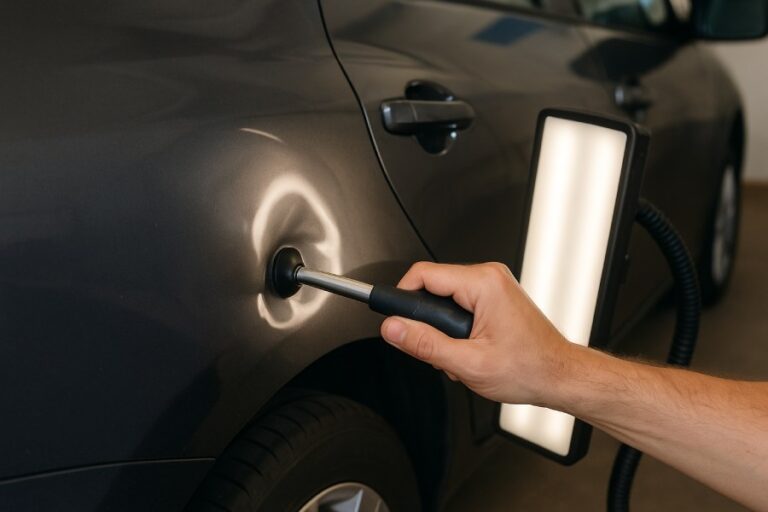
Body lines control how light travels across automotive paint. A skilled technician studies reflection boards or LED lights to identify micro-distortions. In a proper before and after comparison, the repaired body line should flow naturally into adjacent vehicle body panels without ripples, shadows, or uneven edges.
Why Paintless Dent Repair Requires Extra Precision on Creases and Edges
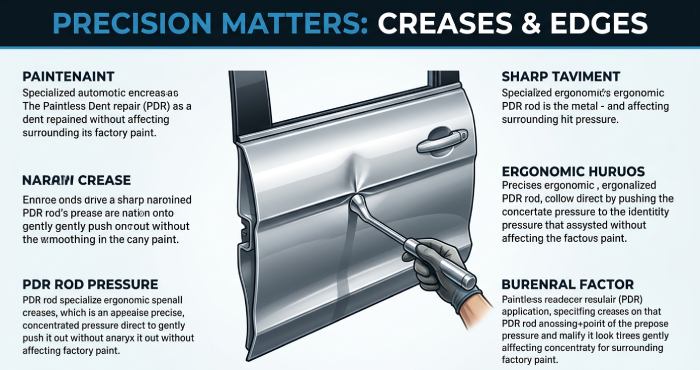
The technical foundation of Paintless Dent Repair (PDR) is precision. Unlike traditional body shop repairs, paintless dent repair does not rely on grinding, body filler, primer, or repainting. Instead, A skilled technician uses specialised tools to restore the damaged contour while preserving the vehicle’s original paint.
This approach is highly effective for many door dings, hail damage repair jobs, minor collision impressions, and cosmetic auto repair needs. But body-line damage raises the difficulty. A crease or edge has a defined peak, and that peak must be rebuilt accurately. If the technician pushes too hard or in the wrong place, the line can become over-raised, softened, or uneven.
Precision Protects Factory Paint
One of the biggest advantages of paintless dent repair is preserving factory paint. Factory-applied automotive paint is difficult to duplicate perfectly, even with expert color matching. Maintaining original paint helps maintain resale value and protects vehicle value, especially when a Carfax report or buyer inspection may note body shop repairs.
Compared with traditional body shop repairs, PDR is often a cost effective repair and an affordable repair for eligible damage. It can also support quick turnaround for private owner vehicles, dealership services, rental fleet operations, and fleet maintenance programs.
Creases Require More Controlled Access
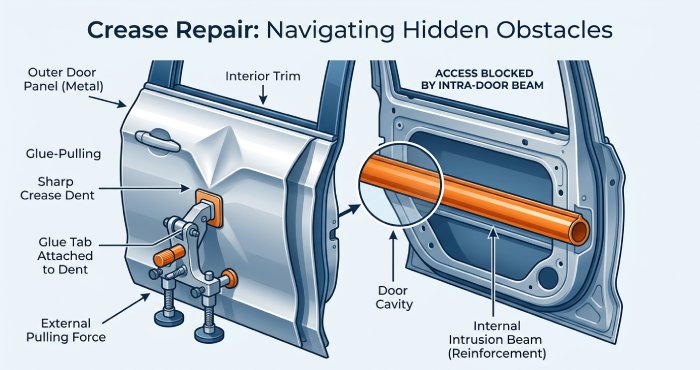
Creases and edges often sit behind braces, intrusion beams, or tight inner structures. Repair technicians may need to remove trim, access panels, liners, or lamps to reach the back side. In some cases, paintless dent removal may be possible only through glue-pulling from the exterior, which requires additional care to avoid stressing automotive paint.
For expectations at a modern shop, Dent Repair should include inspection, damage mapping, repair planning, and a clear explanation of whether PDR, minor paint repair, or body shop repairs are appropriate.
Factors That Influence Repair Difficulty, Cost, and Time
Several variables determine whether a body-line dent is simple, moderate, or highly complex. The size of the dent matters, but it is not the only factor. Location, metal stretch, paint condition, access, and panel material all influence dent removal.
A small dent on a sharp aluminum fender line may be harder than a larger shallow dent on a steel door. Likewise, hail damage repair on multiple body lines can take longer than repairing hail on flatter roof or hood areas.
Key Variables Repair Technicians Evaluate
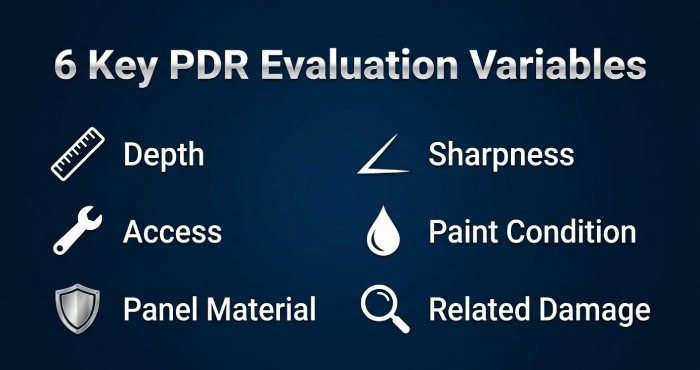
Repair technicians and PDR technicians typically assess:
- Depth: Deep dents can stretch metal and distort the body line.
- Sharpness: A sharp impact may fracture paint or create a hard crease.
- Access: Bracing behind vehicle body panels can limit tool movement.
- Paint condition: Existing chip repair, scratch repair, or Paint Defect Correction may affect repair options.
- Panel material: Aluminum and high-strength steel respond differently during PDR.
- Related damage: Technicians may also check the surrounding panel for scratches, paint chips, additional dents, or other damage that could affect the PDR process.
Hail Damage Repair and Catastrophe Work
Hail damage repair can become especially challenging when impacts spread across multiple creases, hood lines, roof rails, fender edges, and other vulnerable areas. During major hail events, professional Paintless Dent Repair (PDR) can help restore damaged vehicle panels while preserving the factory paint finish.
Hail damage services may include thorough vehicle inspections, detailed damage estimates, insurance claim assistance, and efficient dent repair for vehicles affected by severe storms. Experienced technicians can handle everything from individual hail dents to extensive damage across multiple panels, helping vehicle owners, dealerships, rental agencies, and body shops manage repairs efficiently.
About The Author