
Idaho’s Repair Market Is Growing. What Does That Mean for Paintless Dent Repair?
Executive takeaway
Idaho’s automotive repair and body-shop industries outpaced their national counterparts over the five years to 2026. That supports investigating paintless dent repair opportunities, not declaring a statewide boom. One Idaho Falls specialist reports regular customer arrivals and substantial savings on suitable repairs. Yet the supplied evidence contains no statewide PDR revenue, provider count, or market-share measurement. Drivers should prioritize repair eligibility and comparable estimates. Businesses should test local paid demand before expanding.
Idaho’s repair growth is real, but the PDR boom is unproven
Idaho’s broader repair growth gives paintless dent repair (PDR) specialists a reason to investigate local opportunities. It does not establish a statewide PDR boom.
Idaho’s automotive repair and maintenance industry outpaced its national counterpart over the five years to 2026. However, establishment counts grew roughly in line with the national average, according to IBISWorld’s automotive repair analysis. Faster industry growth therefore did not coincide with unusually rapid growth in repair locations.
The pattern was stronger for auto body shops: both industry growth and establishment growth exceeded national trends. IBISWorld’s body-shop analysis thus provides clearer evidence of an expanding business footprint. Establishments measure locations, however—not the number of paintless dent repairs performed.
Growth and scale tell different stories. Idaho ranks outside the top 25 states for body-shop revenue, employment, and establishments in the same report. Its recent outperformance should be understood alongside that comparatively modest scale.
The supplied IBISWorld findings also place average wages below national averages in both industries. Lower wages alone establish neither higher profitability nor readily available workers. Those judgments require evidence about operating costs, staffing needs, and recruitment conditions.
The outlook further qualifies the growth story. IBISWorld forecasts that Idaho’s automotive repair and maintenance revenue growth will slow and trail the national outlook through 2031.
It forecasts the same pattern for Idaho’s auto body shops. These are projections, not observed outcomes, but they caution against extending recent outperformance indefinitely.
Neither report isolates PDR. Their findings establish broader industry expansion, while leaving the opportunity for this specific repair method unresolved.
Start with the dent, not the market forecast
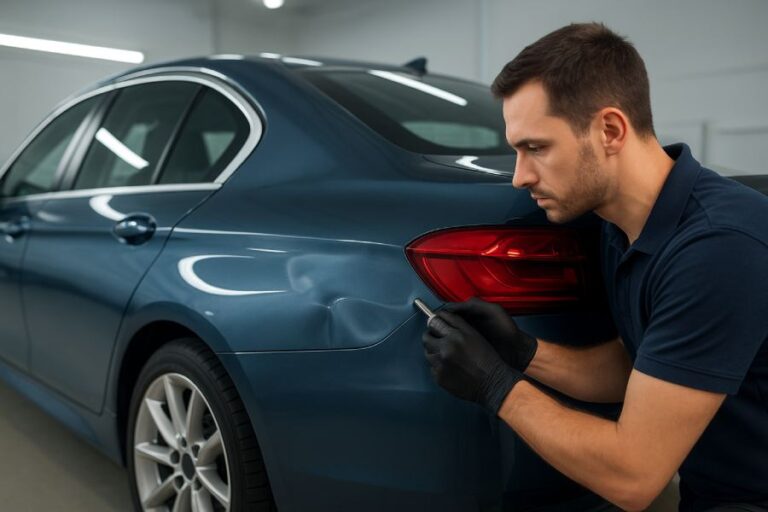
The dent’s condition matters more than a market forecast. Paintless dent repair reshapes damaged metal without replacing or repainting the panel. An Idaho Falls shop’s account describes this distinction from conventional bodywork, while emphasizing that the technique must suit the damage.
Gem State Dent Repair’s consumer guide describes manipulating metal from behind the panel while preserving the existing finish. It identifies paint condition and dent characteristics as eligibility considerations. This is provider guidance, not an independent assessment of how many Idaho vehicles qualify.
Minor dings and hail dents are potential candidates, not automatic approvals. Before booking work, ask a technician to address three questions:
- Paint condition: Is the finish intact, or does the damage also require paint repair?
- Damage shape and severity: Can the contour be restored using PDR? Ask specifically about sharp creases rather than assuming every crease receives the same treatment.
- Panel access: How will the technician reach and manipulate the damaged area?
These questions support professional assessment rather than a do-it-yourself eligibility test. They also help clarify why apparently similar dents may receive different recommendations.
The guide reports typical costs of $75 to $500 or more per dent, depending on size, depth, and location. It also reports 40% to 70% savings compared with conventional bodywork. Neither figure comes from an independently verified survey of Idaho repair prices.
Treat these figures as budgeting references, not promised quotes or guaranteed discounts. The “or more” qualification means $500 is not a firm ceiling.
The useful comparison is between written estimates for the same damage and repair scope. Ask which dents each estimate covers, what work the price includes, and what result the shop expects.
An estimate for reshaping alone is not equivalent to one that also includes paint repairs. Resolve those differences before comparing totals. Choose PDR when the assessment supports it and the proposed result meets your needs—not because an advertised discount looks attractive.
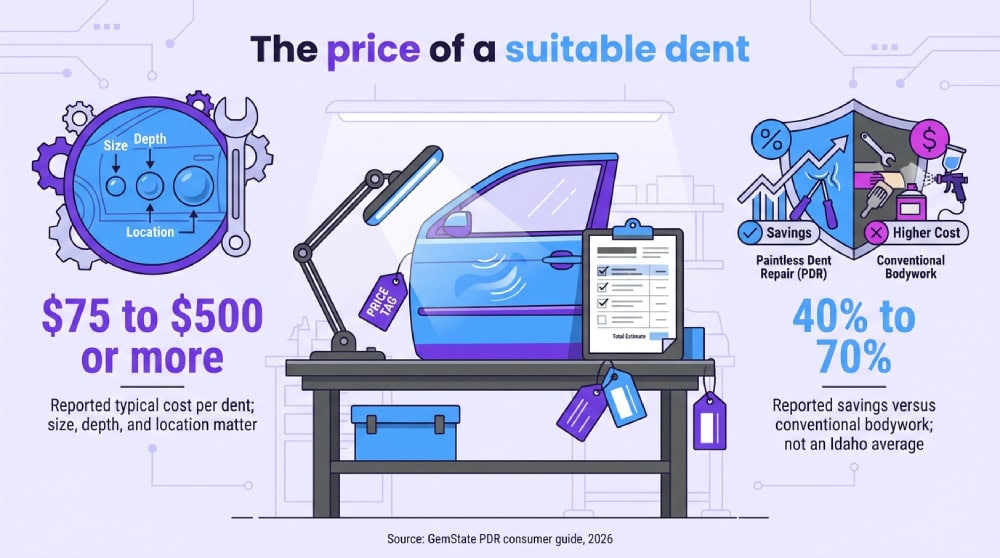
Source: GemState PDR consumer guide, 2026
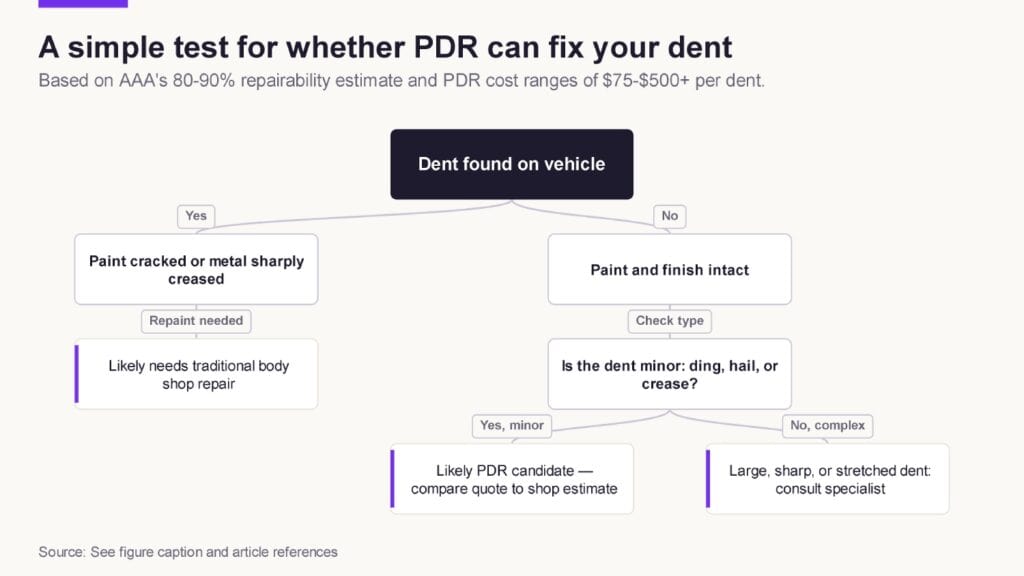
A practical decision guide for car owners assessing whether a dent qualifies for paintless dent repair versus a traditional body shop. Method: Tree built from AAA’s repairability criteria and PDR cost structure described in the consumer guide, combined with the real-world cost comparison reported by an Idaho Falls PDR shop.
What one Idaho Falls specialist shows about cost and demand
Dr. Ding illustrates PDR’s potential value, but cannot establish statewide demand. The Idaho Falls shop has specialized in paintless dent repair since 1993, according to its 2026 account. That history establishes the context of an experienced specialist, not a current market trend.
The shop reports averaging one to three new customers daily, including some traveling from outside Idaho. Without comparable earlier counts, this customer flow cannot establish whether even the shop’s own demand is increasing. Nor does it measure demand across Idaho providers.
Manager Payden Smith compares approximately $6,000 for conventional panel repair with under $1,000 for comparable work at Dr. Ding. He describes PDR as removing damage without replacing or repainting panels when applicable. His comparison illustrates a possible financial advantage, not a guaranteed price for similar-looking damage.
Using $1,000 against the approximate $6,000 figure produces a calculated saving of 83.3%. Because the stated PDR price is lower, the example implies roughly 83% or more in savings. This calculation uses Smith’s approximate comparison; it is not an independently measured average.
That example exceeds the 40–70% range reported in the Gem State PDR guide. Repair scope and case selection could explain the difference, but the supplied evidence cannot resolve it. Neither source establishes an average saving Idaho customers should expect.
Smith also describes PDR as quicker when applicable, without providing measured turnaround comparisons. Faster completion therefore remains a potential benefit rather than a quantified promise. Written estimates covering the same damage would make both price and timing comparisons more useful.
His explanation for demand requires similar caution. Smith attributes part of it to increasingly electronics-laden vehicles making conventional repairs costlier. That is the manager’s interpretation, not a demonstrated causal relationship. His observations support considering PDR for suitable damage, while leaving typical savings and statewide demand unresolved.
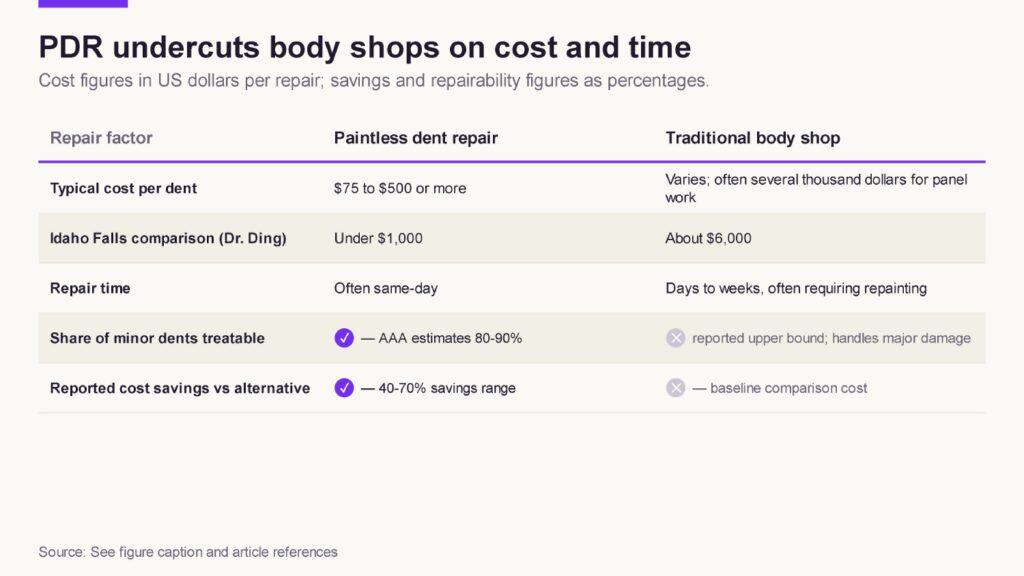
Side-by-side comparison of paintless dent repair and traditional body shop repair, drawn from a national consumer guide and an Idaho Falls shop’s reported pricing. Method: Rows combine national cost-range and savings figures with a single Idaho Falls shop’s reported real-world comparison; no independent price audit was conducted.
Why global PDR estimates cannot size Idaho’s opportunity
Global PDR estimates offer context, but cannot reliably size Idaho’s opportunity. The supplied reports disagree substantially about worldwide service revenue before any attempt to estimate state-level demand.
Four published estimates illustrate the problem:
- $1.4 billion in 2025: Worldwide Market Reports estimates this global service-market size and projects $2.8 billion by 2032.
- $3.33 billion in 2025: Growth Market Reports gives this global estimate and projects $5.89 billion by 2034.
- $2.17 billion in 2026: Research and Markets reports this service-market estimate and projects $3.37 billion by 2032.
- $4.5 billion in 2025: Gem State PDR’s consumer guide cites this estimate and a projection of $6.8 billion by 2032. This is secondhand reporting through a provider’s guide, which references an OpenPR report.
The highest and lowest 2025 estimates differ by approximately 3.2-fold, calculated as $4.5 billion divided by $1.4 billion. Restricting this comparison to 2025 avoids conflating differences between publishers with differences between reporting years.
The spread warrants caution, but does not establish why the estimates diverge. Different definitions, coverage, or methods could contribute. The supplied material cannot confirm the explanation or identify the most accurate estimate.
Repair services should also remain distinct from tools, kits, and software. These are separate revenue categories, not interchangeable measures of spending on repairs. Their existence does not establish that the service reports mixed categories or explain the discrepancy.
Regional figures are meaningful only alongside the estimates they accompany. Growth Market Reports reports a 36.2% North American share with its $3.33 billion global estimate for 2025. Multiplying those figures yields approximately $1.2 billion—a calculation, not a separately measured regional total.
That calculation provides no defensible estimate of Idaho’s share. Allocating continental revenue to individual states would require additional evidence about local repair activity and spending.
All future values listed above are projections, not observed revenue. Even an accurate global estimate would not establish the size of Idaho’s eligible, paying customer base.
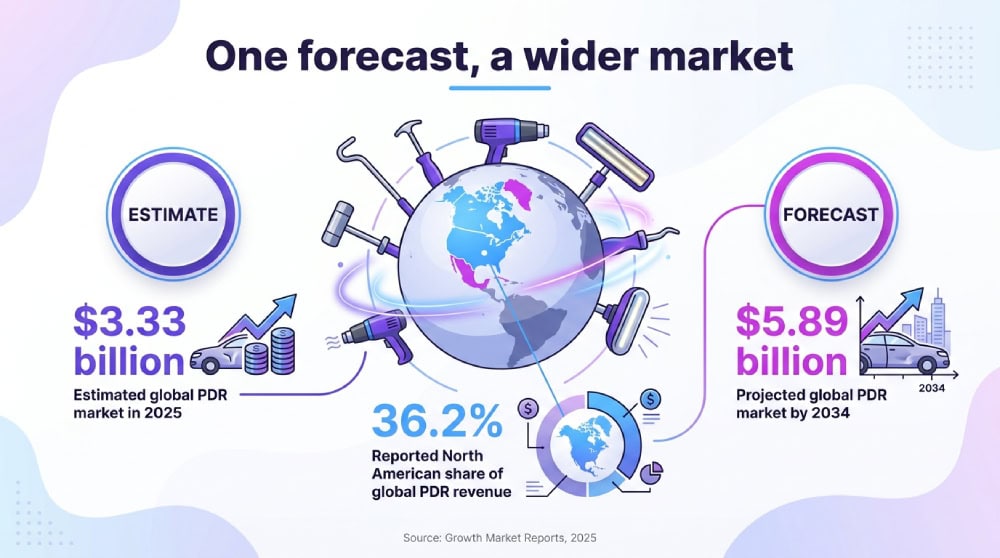
Source: Growth Market Reports, 2025
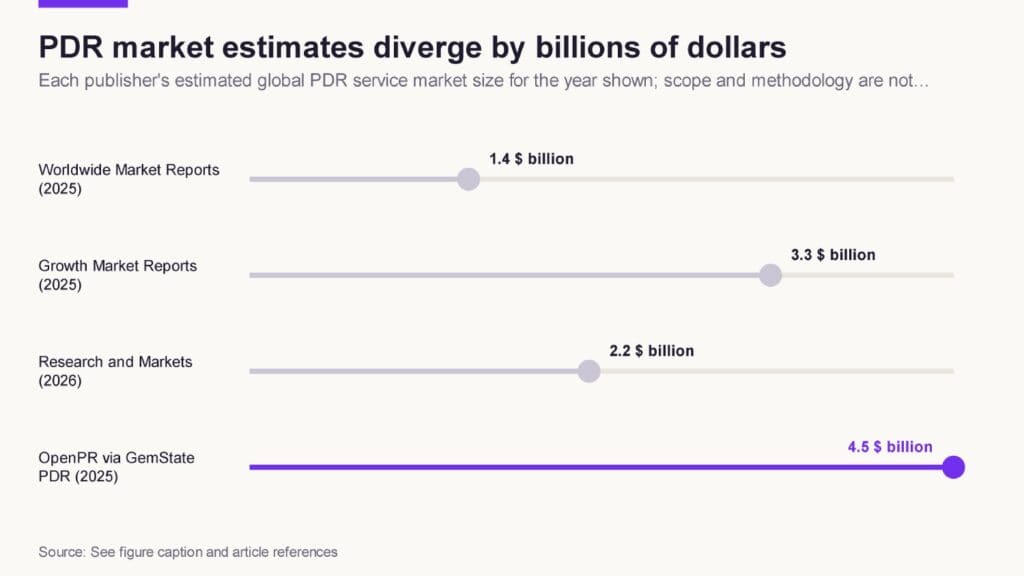
Four market research firms report sharply different figures for the global paintless dent repair service market in 2025-2026. Method: Values taken directly from each publisher’s headline market-size figure for its stated base year; no adjustment made for differing scope or methodology.
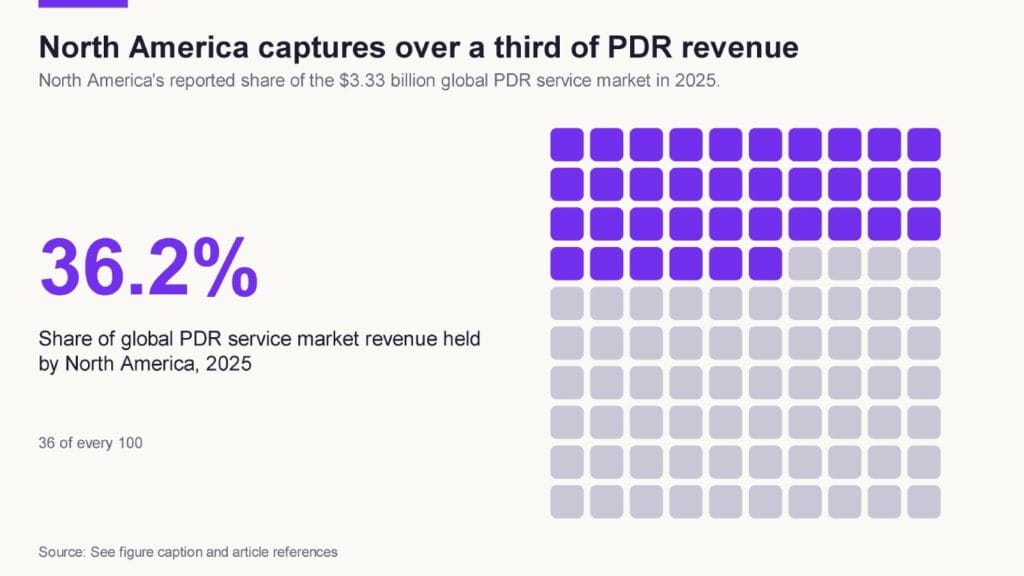
North America’s reported share of the global paintless dent repair service market in 2025. Method: Single percentage figure taken directly from one market research report; not independently verified against alternative regional breakdowns.
The missing link is local, repairable demand
The missing link is local damage that qualifies for PDR and becomes paid work. The IBISWorld automotive repair report measures a broader industry. Its growth findings cannot reveal how many customers have suitable dents.
The same limitation applies to the Idaho auto body report. Across the supplied evidence, statewide PDR revenue, provider numbers, total customer volumes, and market share remain unmeasured. These gaps prevent a defensible estimate of market size or growth.
Revenue growth and eligible dent counts measure different things. Broader revenue gains could reflect higher repair costs or more work outside PDR’s scope. Those are alternative explanations, not findings established by the Idaho evidence. Even additional eligible damage would not guarantee proportional growth in purchased repairs.
The Dr. Ding account offers an operational signal, but no comparable records across businesses or periods. Establishing a broader trend would require multiple shops’ customer-volume records over time. Those records should distinguish inquiries from completed repairs so interest is not mistaken for realized demand.
The Better Business Bureau directory lists another provider, Gem State Dent Repair in Garden City, with a 50-mile service area. That establishes another business presence, not comprehensive coverage or competitive density.
Mobile repair service and affordable cosmetic repairs remain potential growth drivers, not demonstrated Idaho trends. Promotional PDR kits market material cites both themes, but supplies no demonstrated Idaho effect. They identify questions for local investigation rather than evidence that statewide demand has accelerated.
How Idaho shops can test the opportunity before expanding
Editorial recommendations: Idaho shops should test local paid demand before adding PDR capacity. The following checks are proposed business practices, not findings from the supplied research.
First, identify PDR providers separately from general body shops, including businesses offering both services. The Boise-area BBB directory offers a starting point, not a complete statewide count. Verify services, operating areas, and current availability before assessing local competition.
Next, seek comparable customer-volume data from several businesses. Agree on reporting periods and counting rules, then track four measures:
- Inquiries: Unique customers requesting dent-repair information, excluding duplicate contacts.
- Suitable repairs: Vehicles assessed as PDR candidates, with reasons recorded for exclusions.
- Accepted estimates: Customers approving quoted work, rather than merely requesting prices.
- Completed jobs: Finished, paid repairs, counted consistently across participating shops.
These measures separate interest, eligibility, purchase decisions, and completed work. Record why suitable jobs do not proceed rather than assuming every declined estimate has the same explanation.
Examine Idaho hail and minor-collision repair claims where accessible, using consistent geographic areas and periods. Claims are not automatically PDR opportunities. Eligibility still requires assessment, including paint condition and dent characteristics described in the provider’s repair guide.
Compare results across locations and periods before drawing statewide conclusions. A temporary claims surge or one shop’s strong performance may not indicate sustained demand elsewhere.
For drivers, the decision starts with an eligibility assessment and comparable written estimates. Compare repair scope, expected results, price, and timing—not market-growth claims.
For businesses, validate local paid demand before expanding staffing, equipment, or service coverage. Idaho’s broader repair growth makes PDR worth investigating. It does not establish a local PDR boom.
Limitations
- The supplied Idaho industry reports cover broad repair sectors, not PDR separately. They cannot establish PDR market size, growth, or causation.
- Local customer-volume and comparative repair-cost claims come from one shop. They are not representative statewide measurements.
- Eligibility guidance and typical pricing come through a provider’s consumer guide, not independent Idaho research. The underlying AAA evidence is unavailable.
- Global market estimates lack a verified, shared methodology in the supplied evidence. Their differences remain unexplained, and forecasts are not observed growth.
References
- References And Sources
- Automotive Repair & Maintenance in Idaho Industry Analysis, 2026
- Paintless Dent Repair Market Report 2034
- How an Idaho Falls shop became eastern Idaho’s paintless …
- Auto Body Shops in Idaho Industry Analysis, 2026
- Paintless Dent Repair Kits Market Insights Highlight Segment Expansion And Market Leadership
- Paintless dent repair pdr service Worldwide Market Reports
- Paintless Dent Repair near Boise, ID
- Paintless Dent Repair Service Market – Global Forecast …
About The Author