
Hail Brings the Rush. Everyday Dents Build the PDR Business.
Executive takeaway
Hail creates concentrated opportunities for paintless dent repair shops, but it represents less than half of reported revenue. Supplied estimates place hail near one-third of service revenue and at two-fifths of one broader market estimate. Everyday dents, door dings, and fleet work therefore warrant a deliberate business plan. Reported repair costs support considering PDR, but they do not establish shop profitability. Prepare for storm surges while testing non-hail opportunities against actual bookings, technician time, and costs. Use global forecasts as context—not as investment instructions.
Hail fills the schedule—but not the whole market
A hailstorm can fill a repair schedule without accounting for most annual revenue. Paintless dent repair, or PDR, removes suitable dents while preserving the vehicle’s existing paint. The business question is how storm demand fits into a resilient, year-round revenue mix.
The supplied estimates establish hail as a substantial revenue source, not a market majority. They measure revenue rather than vehicle counts, technician hours, or individual shops’ workloads. Those distinctions matter when interpreting a busy storm season.
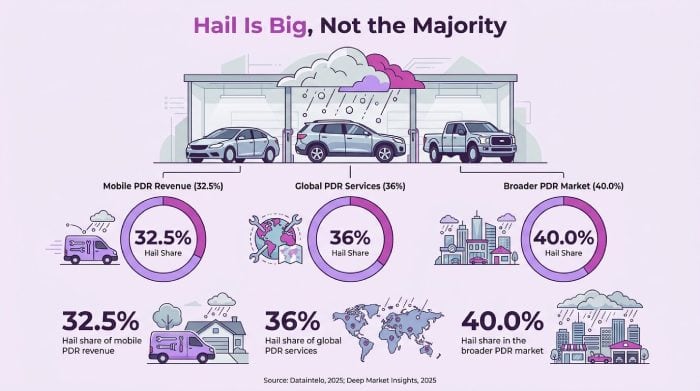
Dataintelo’s mobile PDR services report assigns hail repair 32.5% of mobile service revenue in 2025, making it the largest service category. Its summary describes demand concentrated in particular regions and seasons. That concentration helps explain how hail can dominate schedules without dominating annual market revenue.
Deep Market Insights places hail at 36% of global PDR services, identifying it as the leading revenue segment. Its services market report associates hail work with large, insurance-supported restoration projects. Even within that estimate, other categories collectively generate nearly two-thirds of revenue.
The broader Dataintelo PDR market report puts hail’s share at 40.0% in 2025. That market includes service labor and tools, so its denominator differs from service-only estimates. Its higher figure still leaves most revenue outside hail repair.
Hail does not rank first in every dataset. MarketIntelo’s services segmentation places dent removal at 35.2% of 2025 revenue, ahead of hail at 32.8%. Door-ding repair, crease repair, and other services account for the remainder.
Largest segment does not mean majority, and market share does not measure contribution to growth. Share captures revenue composition at a given time; growth contribution measures how much additional revenue a segment generates. The supplied evidence cannot quantify how much of PDR’s overall growth hail explains.
For operators, the relevant question is how much annual revenue depends on storms—and what supports the business between them. These estimates make non-hail demand central to that question. They do not prescribe the right revenue mix for any particular shop.
Source: Dataintelo, 2025; Deep Market Insights, 2025
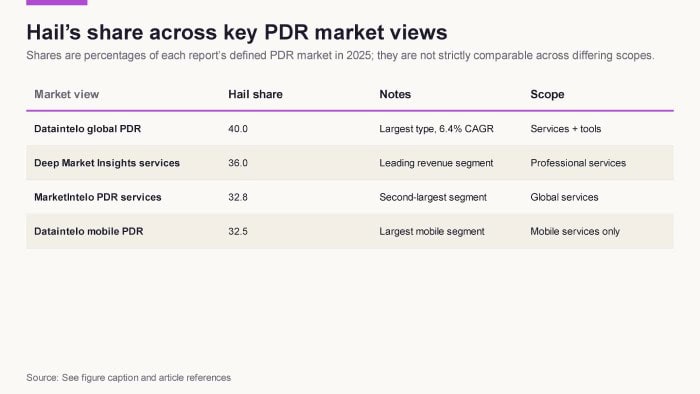
Comparison of hail damage repair shares in four major PDR market studies, highlighting consistent one-third dominance but not majority control of total activity. Method: Table entries are taken directly from segment share figures reported in Dataintelo’s global PDR market, Deep Market Insights’ service market, MarketIntelo’s PDR services segmentation, and Dataintelo’s mobile PDR services analysis.[3][4][11][14]
Why the market estimates disagree
PDR market estimates do not all measure the same activity. Service revenue covers repair work; tools and kits measure equipment sales for professional or DIY use. Broader estimates can combine these categories, making their totals unsuitable for direct comparison.
The supplied 2025 estimates illustrate the spread:
- MarketIntelo values PDR services at $1.8 billion, covering dent removal, hail repair, door dings, and related work.
- Growth Market Reports estimates a $3.33 billion PDR market, offering another total-market benchmark.
- Dataintelo places the broader market at $7.0 billion, including technician labor, tools, lighting, glue-pulling systems, and DIY kits.
- Deep Market Insights estimates $8.9 billion for PDR services, substantially above the other service-only figure.
Scope explains why equipment sales and repair revenue require separate treatment. But scope alone does not resolve the disagreement: the two service estimates differ by nearly fivefold. The supplied summaries do not establish which definitions, assumptions, or methods explain that gap. Agreement on market growth therefore should not be mistaken for agreement on market size.
Keep these figures separate rather than adding them into a combined total. Their coverage overlaps, so addition would double-count activity. Nor does the largest estimate necessarily provide the best measure of demand.
Growth forecasts require similar care. Compound annual growth rate, or CAGR, expresses growth as a constant yearly percentage compounded over time. It summarizes a projected path, not a promise of equal growth each year.
The automotive PDR tools report, titled for 2026–2032, reports 9.19% annual growth. The supplied summary also gives market values for 2025 and 2032. Its forecast window and baseline year therefore need clarification before precise comparisons.
The supplied PDR kits forecast reports 8.4% growth over 2025–2030. Both equipment forecasts exceed MarketIntelo’s stated services growth rate. However, different products and periods prevent a like-for-like comparison.
MarketIntelo’s services forecast states 5.8% growth, with revenue rising from $1.8 billion in 2025 to $2.8 billion in 2034. Those endpoints imply approximately 5.0% annual growth, calculated across nine years. The supplied figures do not reconcile as stated; the available evidence cannot resolve the discrepancy.
Equipment forecasts also cannot identify hail’s contribution to demand or justify a shop’s next purchase. That decision requires evidence about repair needs, expected use, productivity, and costs.
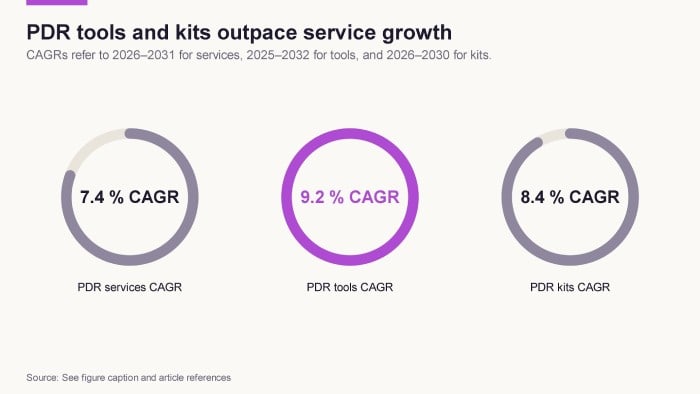
Radial chart comparing growth rates for PDR services, PDR tools, and PDR kits, showing tools and kits expanding faster than services. Method: Growth rates are drawn from Deep Market Insights’ PDR service forecast (7.4% CAGR), the Automotive PDR tools market forecast (9.19% CAGR), and the PDR kits market report (8.4% CAGR).[2][5][11] Values represent compound annual growth over the respective forecast periods.
The repair-cost case for hail PDR
Dataintelo reports hail repair costs of $300–$800 per vehicle for mobile PDR, versus $1,200–$2,500 for traditional body-shop treatment. Its mobile PDR services analysis describes the comparison as equivalent hail damage. PDR pricing varies with dent density and severity.
These estimates support considering PDR when comparing suitable repair options. However, the supplied evidence provides neither matched vehicle-level quotations nor a detailed costing method. Comparing opposite endpoints would create misleading savings expectations rather than a reliable percentage discount.
Customers and claims handlers need estimates for the particular vehicle and damage. Market-report ranges offer context, not binding quotations or evidence that insurers automatically route hail claims to PDR.
Paint preservation offers a potential advantage beyond the quoted repair bill. MarketIntelo’s mobile paint repair analysis describes PDR as maintaining original paint, potentially avoiding refinishing where the method suits the damage. The supplied evidence does not establish a resale premium or quantify time saved.
Concentrated post-storm demand may create opportunities to coordinate scheduling and deployment. Deep Market Insights describes large insurance-supported hail restoration projects. Yet handling many vehicles does not itself demonstrate greater output per technician or shorter repair cycles.
Customer savings, shop revenue, and profit are different measures. A lower repair bill can benefit the payer without increasing the repairer’s margin. Assess the business case through three separate questions:
- Customer savings: How does the actual PDR quotation compare with an appropriate alternative?
- Shop revenue: How much paid work does the shop complete?
- Profit: What remains after technician pay, travel, deployment, equipment, and overhead costs?
The evidence does not quantify those operating costs or establish productivity gains. Concentrated demand and paint preservation are possible advantages, not proof of superior hail-repair margins.
The hail-versus-non-hail comparison illustrates different repair uses, not a universal recommendation. Storm dents and everyday damage both require individual assessment. The supplied reports provide no technical eligibility checklist, so prices and segment shares cannot determine whether a vehicle qualifies for PDR.
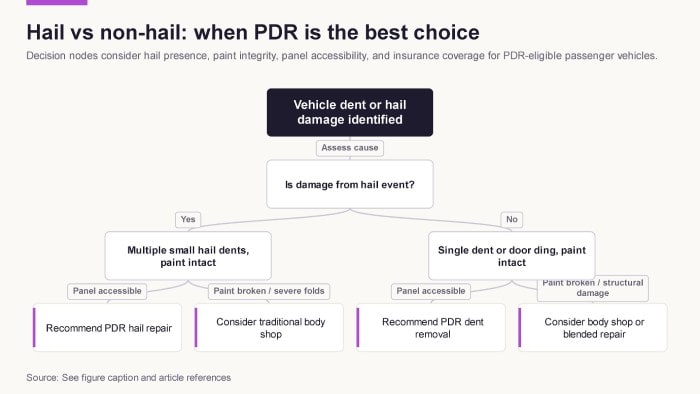
A practical decision guide showing when hail or non-hail dents should be routed to PDR rather than traditional body shops, based on damage type, paint condition, and insurance context. Method: Nodes and pathways are derived analytically from the segment shares and cost comparisons reported in global PDR, mobile PDR, and mobile paint repair market studies, distinguishing hail-driven catastrophe work from routine dent and door-ding repairs.[1][3][4]
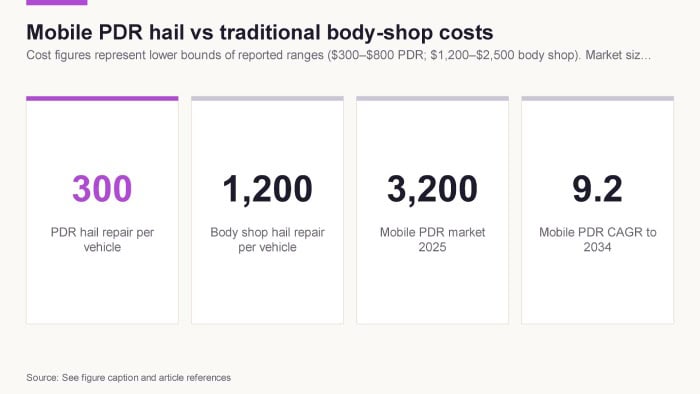
Key cost and growth statistics illustrating the economic rationale for routing hail repairs to mobile PDR rather than traditional body shops. Method: Headline numbers combine mobile PDR hail repair cost ranges and traditional body shop hail repair costs from Dataintelo’s mobile PDR report, along with the mobile PDR market’s total size and CAGR.[4] Values are sourced directly; no additional calculations beyond selecting midpoints were performed.
Everyday dents deserve a year-round plan
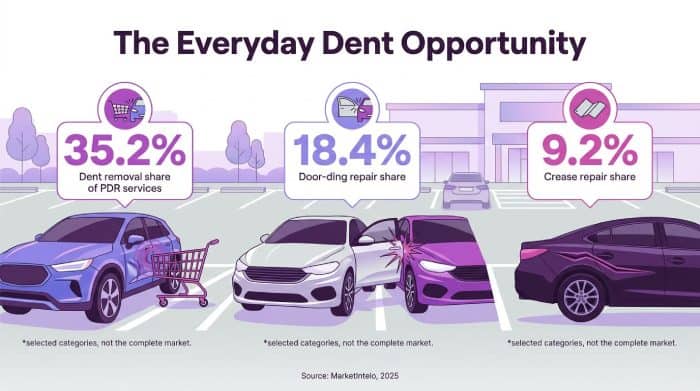
Everyday dents deserve a deliberate place in a PDR shop’s year-round plan. In MarketIntelo’s services breakdown, dent removal represents 35.2% of global market value in 2025, ahead of hail repair at 32.8%. Door-ding repair contributes 18.4%, while crease repair accounts for 9.2%.
Dent removal and door-ding repair together represent 53.6%, calculated from this dataset rather than reported separately. These categories exceed half the estimated services market value. That establishes their scale within this segmentation—not their contribution to growth or reliability across seasons.
Non-hail categories address several reasons customers seek repairs. Growth Market Reports identifies parking-lot dents, minor impacts, and transport-related damage as sources of PDR demand. These needs broaden the potential customer base beyond owners responding to storms.
Dealer and fleet reconditioning offer commercial channels for this work. Deep Market Insights includes both activities in its account of PDR demand. Reconditioning prepares vehicles for sale or continued use, including repairs to suitable dents and minor body damage.
These channels are potential sources of repeat work, not guarantees of stable income. The evidence does not establish customer return frequency or the reliability of commercial repair volumes. Operators must test the broad opportunity against actual account needs.
Three practical options follow:
- Develop dealer relationships. Ask reconditioning managers which repairs they need and how they select providers. Consider a limited trial before committing regular capacity.
- Discuss fleet requirements. Explore vehicle availability, repair approvals, and downtime expectations before proposing a service arrangement.
- Follow up with customers. With permission, check satisfaction and explain other suitable PDR services. Measure future bookings rather than assuming they will follow.
Evaluate these efforts through completed jobs, repeat bookings, technician time, and account-servicing costs. Those measures distinguish recurring demand from inquiries that rarely become paid work. The goal is a tested non-hail customer base, not diversification in name alone.
Source: MarketIntelo, 2025
Your local market may tell a different story
Global market shares provide context, not a forecast of one shop’s workload. Regional and vehicle-type estimates illustrate market composition, but they cannot identify a local operator’s customers or booking patterns.
Three reports assign North America different shares for 2025:
- Deep Market Insights estimates 34% of the PDR service market, placing North America first within its dataset.
- Growth Market Reports estimates 36.2% of global PDR revenue under its total-market definition.
- Dataintelo estimates 42.0% of global PDR revenue under its broader market definition.
These estimates should remain separate. Averaging them would create a new figure without establishing comparable definitions or methods.
A North America-centered interpretation also misses substantial activity elsewhere. MarketIntelo’s services study assigns Asia-Pacific 38.5% of global PDR services revenue. The supplied evidence does not reconcile the regional estimates or establish a common ranking across reports.
Vehicle categories raise a related measurement problem. Deep Market Insights places passenger cars at 53% of total PDR demand. The supplied summary does not define that demand measure sufficiently for direct comparison with revenue shares.
Dataintelo assigns passenger cars 84.0% of PDR revenue in 2025. The different metric and unverified vehicle classifications prevent treating this as a directly comparable estimate.
Neither passenger-car figure separates hail repairs from other dent work. Likewise, regional shares do not establish Boise’s customer mix or predict GemState PDR’s booking calendar.
Local records should therefore connect market context to operating decisions. Review:
- Customer mix: Separate private owners, dealers, and fleets, alongside vehicle and repair types.
- Seasonal bookings: Track when inquiries become completed jobs, distinguishing hail from ordinary dents.
- Commercial opportunities: Assess prospective volume, scheduling requirements, and repeat-work potential.
Use these findings to guide staffing and equipment decisions. Global estimates frame useful questions; local evidence must answer them.
Build storm capacity without betting on storms
Hail is a substantial PDR segment, but none of the retained estimates gives it a revenue majority. Its precise contribution to market growth remains unresolved. The practical response is to prepare for concentrated storm demand while developing routine dent work. These are recommendations to test, not demonstrated guarantees of profitability.
First, plan storm capacity before committing to expansion. A hail-readiness checklist could cover insurance documentation, damage photographs, estimates, scheduling, and customer updates. Deployment plans should specify service areas, technician availability, travel budgets, and conditions for accepting distant work.
Review previous jobs before adding mobile capacity. Lower customer repair costs do not establish higher shop margins. Track the operating measures needed to judge expansion:
- Revenue by repair type: Separate hail, ordinary dents, door dings, and other work.
- Technician hours: Record repair, travel, and administrative time.
- Job costs: Include technician pay, mileage, lodging, equipment, and relevant overhead.
- Repeat bookings: Identify customers and relationships that generate returning work.
Use those records to test scenarios that include periods with little hail demand. Before buying tools, identify the repair bottleneck each purchase would address and estimate likely use. A market forecast cannot establish whether a particular purchase will pay for itself.
Second, give routine dent work its own customer-development plan. Growth Market Reports’ synopsis distinguishes concentrated hail demand from ongoing parking-lot dents and minor collisions. That distinction supports separate approaches to storm response and everyday bookings, without proving either will succeed locally.
Build on the dealer, fleet, and customer-follow-up trials described above. Expand them only when completed jobs, repeat demand, and costs support the decision. This connects diversification to measured performance rather than market-share assumptions.
For an operator such as GemState, this framework offers questions—not claims about existing capabilities or local market share. Let observed demand, technician availability, and job economics determine staffing and equipment decisions. Prepare to capture the hail rush without making storms a prerequisite for the business to work.
Limitations
- This analysis checks the draft against supplied summaries of commercial market reports. Full source text and underlying methods were unavailable for independent verification.
- Market definitions and estimates differ substantially. Revenue shares do not establish repair volumes, local workloads, or hail’s contribution to market growth.
- Franchise figures attributed to differently titled reports were excluded, along with unsupported certification and local-market claims.
- Repair-cost ranges are not matched quotations. Forecast inconsistencies remain unresolved, and the evidence does not establish profitability, productivity gains, or causal climate effects.
References
- Top Companies Analysis
- Paintless Dent Repair Kits Market Report 2026
- Paintless Dent Repair Market Size, Share & Forecast …
- dataintelo.com · report · mobile-paintless-dentMobile Paintless Dent Repair Services Market Research Report 2033
- 汽車無痕凹陷修復(PDR)工具市場:全球市場預測,2026-2032年
- Paintless Dent Repair Market Report 2034
- Paintless Dent Repair Service Market Forecast to 2031
- Paintless Dent Repair Services Market Research Report …
About The Author