
Mobile PDR Is Growing. Should Your Shop Add Another Van?
Executive takeaway
Mobile PDR warrants investigation, but market forecasts cannot justify another van alone. One commercial estimate values global mobile revenue at USD 4.1 billion in 2024 and projects USD 7.5 billion by 2033. PDR can reduce costs and downtime for suitable dents compared with traditional bodywork. Mobile delivery adds convenience, but the evidence does not quantify its advantage over fixed-shop PDR. Test local demand, repair suitability, technician capacity, and route economics before expanding. A hybrid operation may provide flexibility without committing every repair to mobile delivery.
The repair opportunity is moving beyond the bay
When does taking the technician to the vehicle improve the business? For a shop considering another van, that question matters more than a rising market forecast. Expansion makes sense when mobile delivery improves the economics of serving suitable work.
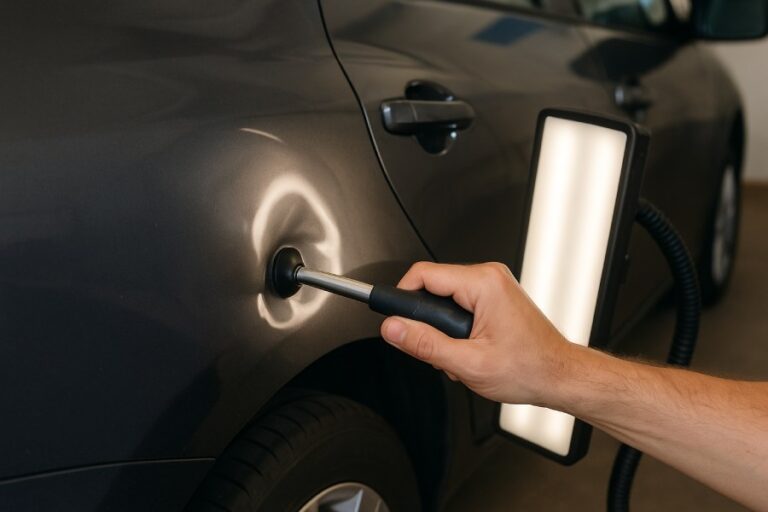
Paintless dent repair, or PDR, reshapes suitable dents while preserving the existing paint. Mobile PDR changes where technicians perform the repair, not the underlying technique. Growth Market Reports defines mobile PDR services around technicians travelling to customer-specified locations. A shop can therefore evaluate mobile service without treating it as a replacement for its bays.
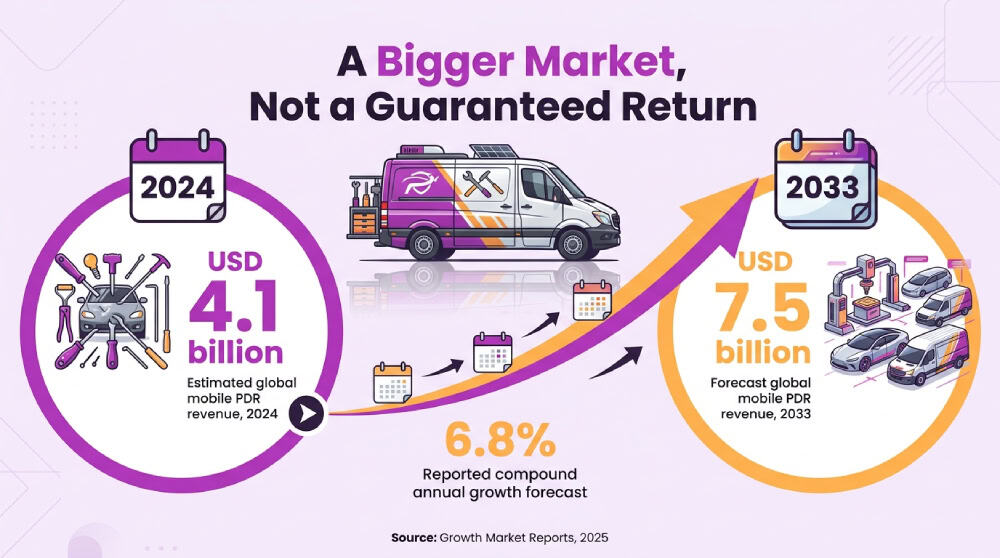
The commercial opportunity appears substantial, although its size remains an estimate. The publisher values global mobile PDR revenue at USD 4.1 billion in 2024 and projects USD 7.5 billion by 2033. It reports a 6.8% compound annual growth rate, meaning the annualized growth rate across its forecast period.
These figures describe estimated revenue and projected expansion, not work already booked by repair operators. They reveal neither demand within a particular service radius nor earnings after travel, labor, and vehicle costs. A global forecast can justify investigation; it cannot establish whether local expansion will pay.
The business change is delivery, not dent removal. Taking repairs to customers may reduce their travel while increasing the operator’s driving and coordination. The relevant comparison is what each delivery model requires to complete suitable work profitably.
That leaves room for a selective mobile offering alongside an established workshop. The decision starts with identifying which repairs and customers benefit from on-site service. Buying another van should follow that assessment, not precede it.
Source: Growth Market Reports, 2025
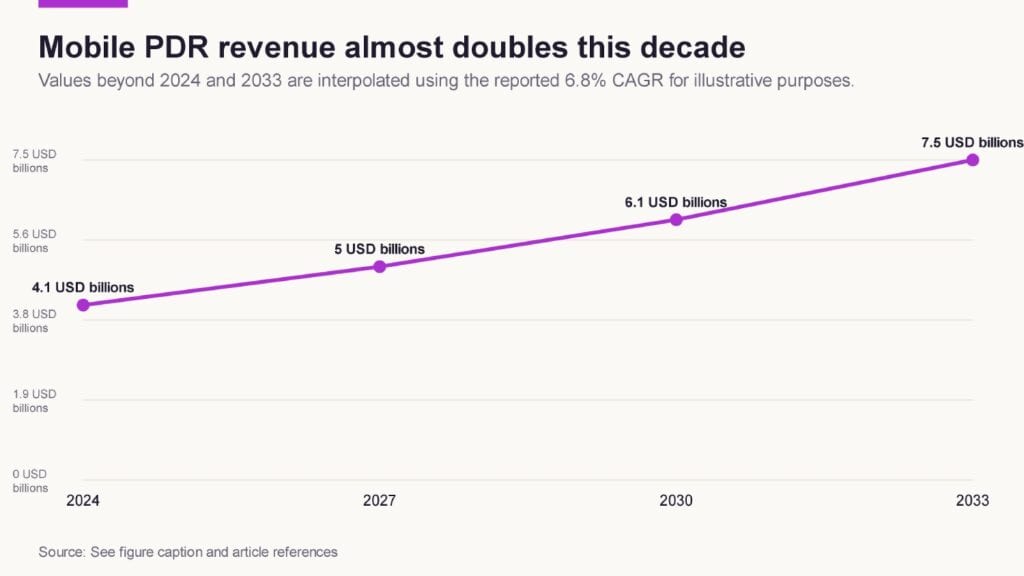
A simple trend line shows projected global mobile PDR services revenue rising from USD 4.1 billion in 2024 to USD 7.5 billion by 2033. Method: Endpoints taken from Growth Market Reports’ mobile PDR services forecast; intermediate years interpolated assuming a constant 6.8% CAGR for visualization.
Read the market numbers before betting on them
PDR forecasts suggest growth, but they do not establish one reliable market size. Before using them to justify investment, separate the revenue categories and forecast periods each publisher describes.
Three estimates for 2025 illustrate the problem:
- USD 3.33 billion: Growth Market Reports’ PDR market estimate provides the narrower baseline in the supplied evidence. It projects USD 5.89 billion by 2034, with reported compound annual growth of 6.8%.
- USD 7.0 billion: Dataintelo’s PDR ecosystem estimate includes tools and services. It forecasts USD 11.83 billion by 2034, reporting 6.0% annual compound growth.
- USD 8.9 billion: Deep Market Insights’ PDR service estimate focuses on service revenue. It projects USD 13.66 billion by 2031, with reported annual compound growth of 7.4%.
Different definitions may explain some variation, but they do not resolve it. The service-only estimate exceeds the tools-and-services estimate. These totals therefore do not form a consistent hierarchy of narrower and broader markets. The supplied summaries cannot establish which coverage boundaries or methods explain the mismatch.
A much larger figure requires greater caution. Dataintelo’s car body repair report estimates USD 212.5 billion in total revenue for 2025 and assigns 24.2% to PDR. Multiplying those figures produces approximately USD 51.4 billion. This is a segmentation-derived calculation, not a comparable standalone PDR estimate.
That calculation remains an unresolved outlier. It should neither corroborate the smaller estimates nor anchor an optimistic investment case. Numerical precision does not compensate for uncertain definitions.
The growth forecasts offer a more consistent, but still limited, picture. The three PDR reports project annual compound growth between 6.0% and 7.4%; the broader car body repair forecast reports 4.2%. These are publisher expectations across different forecast periods, not observed growth. The evidence also does not establish that their underlying datasets are independent.
Mobile estimates introduce another comparability problem. For an explicitly earlier-year comparison, Growth Market Reports’ mobile forecast starts at USD 4.1 billion in 2024 and projects USD 7.5 billion by 2033. The publisher reports 6.8% annual compound growth. Dividing its 2024 mobile estimate by another publisher’s 2025 total would mix years and unverified market boundaries.
Figure: Mobile PDR market growth
The forecast projects mobile revenue growth from 2024 to 2033. These estimates establish neither a comparable mobile market share nor share gains.
Mobile revenue can grow without capturing a larger proportion of PDR spending. For shop owners, the defensible conclusion is narrower: investigate local demand rather than treating global expansion as proof of available work.
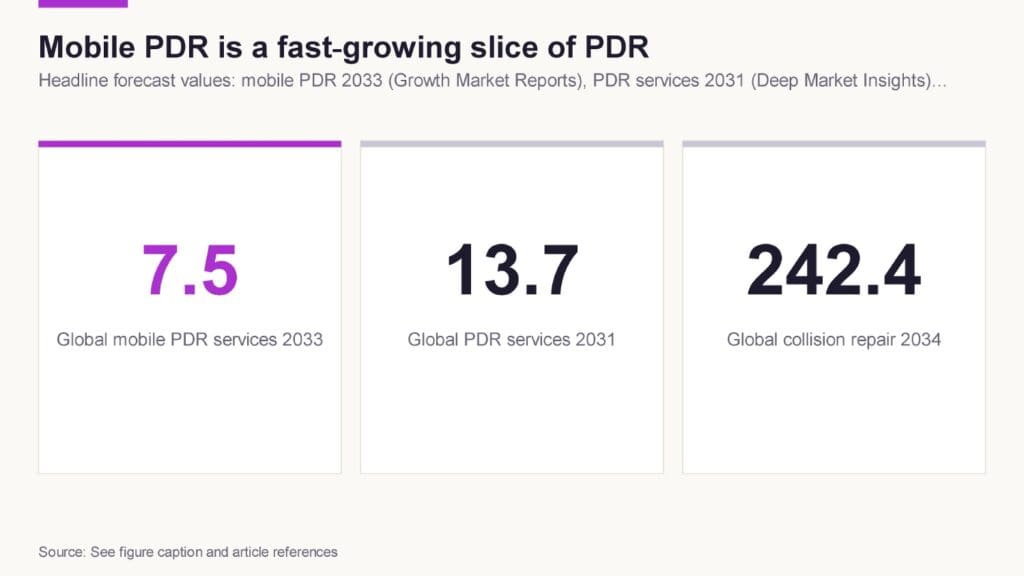
Key headline numbers illustrate that mobile paintless dent repair is expanding nearly as fast as the broader PDR service market while operating inside a much larger collision repair universe. Method: Values taken directly from Growth Market Reports, Deep Market Insights, and Polaris Market Research, choosing mid‑decade snapshots for comparability rather than aligning exact base years.
Customers buy less disruption, not just dent removal
PDR’s repair advantages and mobile service’s convenience are separate benefits. PDR preserves the original paint on suitable dents. Mobile delivery changes where that work happens, potentially eliminating a separate customer journey.
The reported technical savings are substantial. Dataintelo’s car body repair report attributes roughly 60–70% less vehicle downtime to PDR compared with traditional methods involving sanding, filling, priming, and repainting. That comparison concerns the repair technique, not whether a technician arrives in a van.
The cost comparison has the same boundary. MarketIntelo’s mobile paint repair analysis reports 50–70% lower direct repair costs for PDR than traditional bodywork on applicable dents, including small dents with intact paint. These figures should inform preliminary discussions, not become blanket discounts promised before inspection.
The supplied summaries do not provide controlled, repair-level comparisons. They cannot establish how savings vary with damage severity, local prices, or working conditions. Treat both ranges as indicative advantages for suitable work, not guaranteed outcomes.
The evidence does not quantify mobile’s incremental savings over fixed-shop PDR. Both use the same technique. Avoiding a customer journey offers a separate convenience benefit, but its value remains unmeasured here. Preserving factory paint likewise does not establish a guaranteed resale premium.
Customers need clear distinctions between repair suitability and delivery location:
- Mobile PDR: Suitable damage must also be repairable at the proposed location. Confirm vehicle access and workable site conditions before promising on-site completion.
- Fixed-shop PDR: The same technical limits apply, but a dedicated workspace may support work unsuitable for mobile delivery. Paintless repair itself does not require repainting.
- Conventional repair: Damage outside PDR’s capabilities needs another repair method. The required facilities depend on the work, including preparation and painting capacity when refinishing is necessary.
Translate convenience into specific commitments rather than a promise of no disruption. As operating recommendations, distinguish arrival windows from repair duration, explain provisional estimates, and confirm location requirements. Tell customers what happens if inspection shows that on-site repair cannot proceed.
The strongest promise is therefore narrower than faster and cheaper everywhere: suitable dent repair with fewer logistical demands and clearly stated limits.
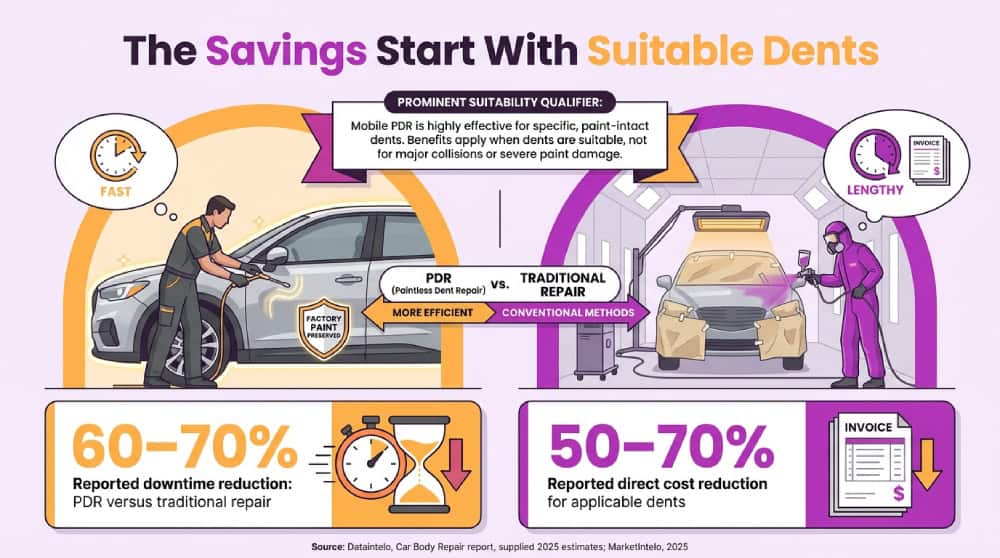
Source: Dataintelo, Car Body Repair report, supplied 2025 estimates; MarketIntelo, 2025
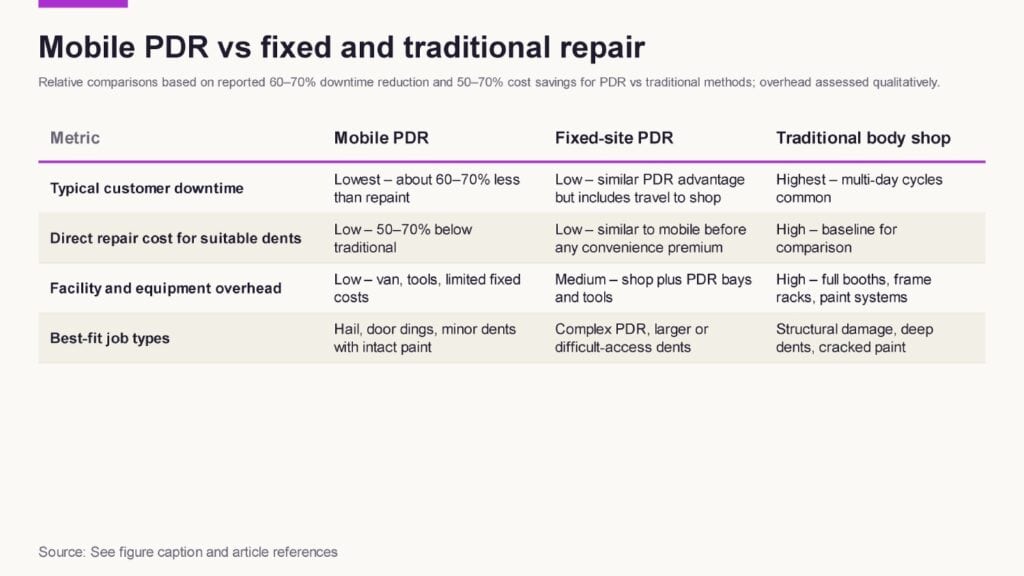
Contrasting mobile PDR with fixed‑site PDR and traditional body shops highlights differences in downtime, direct costs, and facility overhead that underpin mobile adoption. Method: Qualitative categories derived from Dataintelo’s quantified downtime and cost advantages for PDR over traditional repair and MarketIntelo’s cost comparisons, applied consistently across delivery models.
The best mobile job starts with the right dent
Screen the dent before promising the visit. Otherwise, a mobile booking can become a journey to explain why work cannot proceed.
Paint condition is central to that assessment. Deep Market Insights identifies cracked paint, deep dents, stretched metal, and structural damage as PDR constraints. Cracked paint cannot be restored through reshaping alone. Deep dents and stretched metal require closer assessment, while structural damage extends beyond cosmetic dent removal.
The publisher estimates that PDR suits approximately 60% of dent cases. This is a broad market assessment, not a universal acceptance rate. The evidence provides neither a standardized inspection protocol nor a case population matching any particular shop’s inquiries.
A separate MarketIntelo report estimates that combined technologies can address 70–85% of minor damage without traditional bodywork and repainting. Its scope includes broader mobile cosmetic repair and techniques beyond PDR, such as advanced paint-matching. The supplied summary does not detail the treatment boundaries behind that claim.
These percentages describe different populations and capabilities. One concerns dent cases suitable for PDR; the other concerns minor damage addressed through a broader toolkit. Neither averaging them nor substituting one for the other would produce a defensible mobile PDR workload estimate.
A proposed screening process should separate preliminary assessment from final authorization:
- Review photos before scheduling. Request an overall panel view, close-ups, and several angles showing any paint damage. Keep the assessment provisional until inspection.
- Confirm suitability before starting. Check damage, paint condition, access, and the working location. Agree on scope and expected results before proceeding.
- Provide a referral option. Explain when the customer needs conventional bodywork, further assessment, or a fixed-facility PDR appointment.
Unsuitable for mobile service does not necessarily mean unsuitable for PDR. Some paintless repairs may require working conditions or support better provided at a shop. Assign the repair method first, then the location.
Track photo-screened bookings, on-site rejections, and shop transfers separately. This tests whether screening protects technician time without turning preliminary estimates into unrealistic promises.
Why North America matters—and where repeat work may come from
North America represents a substantial mobile PDR market, but its lead needs careful interpretation. Growth Market Reports estimates regional revenue of USD 1.56 billion in 2024, approximately 38% of global mobile PDR revenue. That makes it the largest individual region, not a majority of the worldwide market. Other regions collectively account for approximately 62%.
Regional scale does not establish local booking frequency. Deep Market Insights identifies high vehicle ownership, strong insurance penetration, and frequent hail events as North American PDR demand drivers. These factors provide context, but they do not reveal demand within a particular shop’s territory.
Commercial relationships offer a possible route to repeat assignments. Dataintelo’s PDR tools analysis describes insurer partnerships and corporate fleet maintenance programs as features of North American demand. Because this is a tools-market report, those observations are contextual evidence, not direct measures of mobile-service profitability.
Dealerships and fleet yards deserve investigation as concentrations of potentially suitable work. The operating hypothesis is simple: more repairable vehicles per stop could reduce travel between paid jobs. It holds only when vehicles, approvals, and workable site conditions are available together.
Different customer channels therefore require different tests:
- Retail appointments: Can nearby bookings form productive routes without excessive travel?
- Dealer lots: Can staff identify eligible vehicles and secure approvals before arrival?
- Fleet yards: Can repair visits align with vehicle availability without disrupting operations?
These are operating questions, not profitability rankings. A multi-vehicle stop may deliver little completed work if vehicles remain unavailable. Conversely, a tightly grouped retail route could outperform a poorly coordinated commercial account.
Hail demand requires a separate boundary. Deep Market Insights’ service-market estimate attributes approximately 36% of global PDR service revenue to hail damage repair. That figure describes worldwide PDR services overall, not North American mobile demand.
The supplied summary of the mobile PDR report distinguishes its scope from fixed workshops and catastrophe-hail crews. Its regional estimate should therefore not be treated as a combined measure of everyday routes and disaster-response operations.
North America’s scale supports investigating commercial relationships alongside retail appointments. The strongest local opportunity may be repeat access to suitable vehicles, rather than a larger geographic territory.
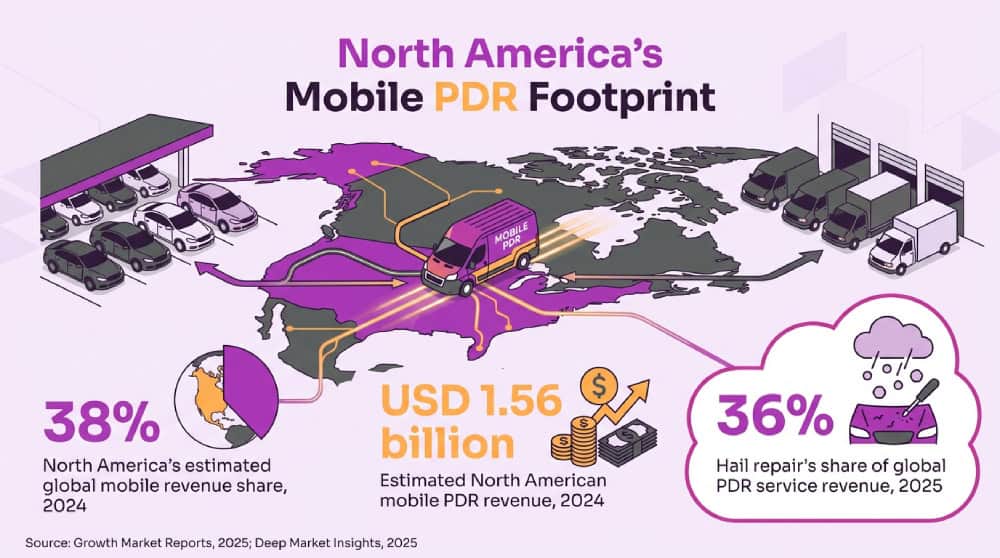
Source: Growth Market Reports, 2025; Deep Market Insights, 2025
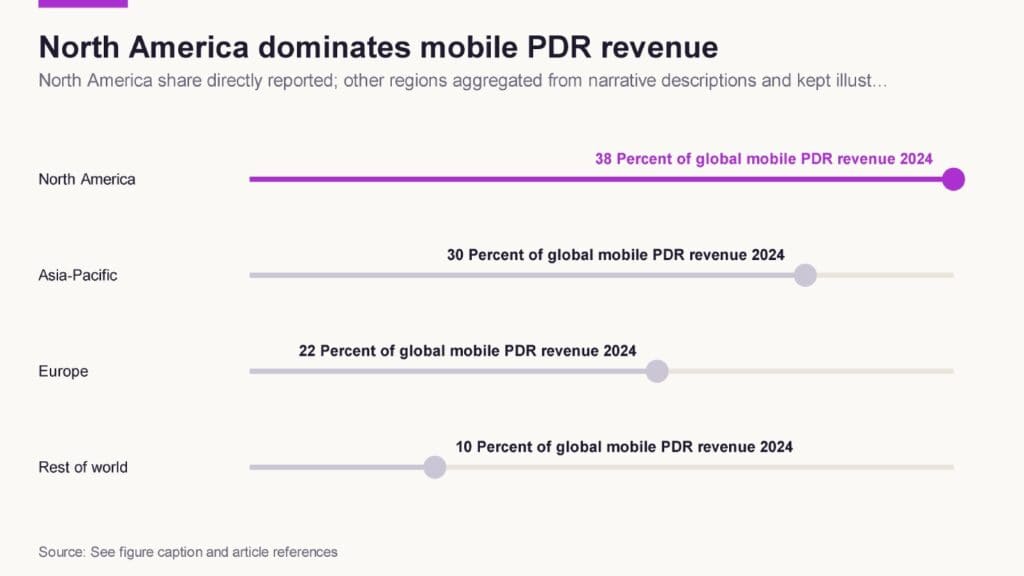
A radial chart visualizes the distribution of mobile PDR services revenue by region, emphasizing North America’s leading 38% share. Method: Regional shares taken from Growth Market Reports’ mobile PDR services study; remaining regions grouped proportionally for illustration.
A van earns money through productive technician time
A van’s earning capacity depends on productive technician time, not distance covered. Suitable repairs, demonstrated skill, and manageable travel should guide scheduling.
Equipment enables the work, but tool-market growth cannot establish a van’s return. Research and Markets estimates global automotive PDR tool sales at USD 1.5 billion in 2025, reaching USD 2.0 billion by 2032. This forecast describes equipment demand, not bookings, repair quality, or operating profit.
The supplied evidence identifies rods, lights, glue-pull systems, and dent lifters as relevant equipment. Dataintelo’s tool-market analysis describes exterior glue pulling as useful when rear-panel access is constrained. These capabilities do not establish a universal equipment budget or expected payback. Match the kit to work the technician can confidently complete.
Schedule around demonstrated skill, not simply an available van. As a proposed operating rule, assign repairs by technician capability and reserve time for assessment and quality checks. Before dispatch, confirm vehicle availability, approvals, expected work, and site conditions. Allow technicians to redirect unsuitable jobs rather than forcing every booking into mobile delivery.
Three scheduling approaches deserve trials:
- Dealer service days: Reserve recurring visits and request candidate vehicles beforehand. Test whether sufficient approved work is ready on arrival.
- Fleet-yard visits: Coordinate with actual vehicle availability. Record waiting caused by missing keys, approvals, or vehicles.
- Geographic booking clusters: Offer designated appointment windows for particular areas. Compare travel savings with cancellations or bookings lost through reduced flexibility.
Evaluate these approaches with consistent route records. The following measures are proposed management tools, not industry benchmarks:
- Travel time: Include journeys from the base, between stops, and back.
- Repair time: Separate hands-on work from assessment, setup, waiting, and administration.
- Completed work: Count repairs and vehicles while recording differences in complexity.
- Cancellations: Record timing and reasons, including unavailable vehicles and unsuitable damage.
- Rework: Track corrective time and return visits against the original job.
- Revenue by route: Connect completed work with revenue and total technician time committed.
Interpret the measures together. Higher route revenue may reflect harder repairs or longer working days rather than better scheduling. Revenue also remains distinct from profit; compare relevant operating costs before judging returns.
A hybrid shop-and-mobile model offers a design worth testing. The shop could support appropriate complex PDR, supervised training, and quality reviews while mobile technicians handle suitable on-site work. Clear transfer criteria would preserve that support without making every appointment dependent on a bay.
Judge the arrangement by repair quality, completed work, and total technician time across both channels. Keeping either channel busy is not an adequate performance objective.
Build reliable demand without depending on the next hailstorm
Build the customer mix around ordinary weeks, not the busiest week after a storm. Diversification means limiting dependence on one demand trigger, not assigning every channel an equal share.
Define each channel’s intended role, then test it against local results:
- Retail: Suitable one-off repairs with clear estimates and appointment windows.
- Dealers: Scheduled visits for approved work, with vehicles confirmed beforehand.
- Fleets: Recurring inspection or repair arrangements aligned with vehicle availability.
- Insurer-linked work: Assignments with clear authorization, documentation, and payment responsibilities.
Recurring arrangements could make upcoming work more visible. However, the supplied evidence does not measure revenue stability. A recurring calendar entry is not guaranteed volume. Agree on booking cutoffs, vehicle readiness, approval contacts, cancellation terms, and any minimum workload. Track completed repairs and collected revenue separately from promised appointments.
Hail deserves its own capacity plan. Dataintelo’s PDR tools report describes storms damaging hundreds of vehicles locally and generating bulk insurer and fleet work. This supports planning for surges, not assuming that a storm backlog will sustain permanent capacity.
Separate temporary response from permanent expansion. Limited-term capacity might handle a surge without displacing established customers, subject to technician availability and quality controls. Permanent staffing and vehicle commitments remain after a temporary backlog clears.
Competition also warrants local assessment. Deep Market Insights identifies increasing competition from entrants and franchises, but does not establish conditions in every service area. Market growth alone cannot protect an operator’s prices or accounts.
DIY kits represent adjacent competition, not evidence about professional booking preferences. MarketIntelo’s kits report links DIY interest to cost savings, online tutorials, and tool access. Those observations establish neither demand for app-based professional bookings nor failed DIY repairs as a dependable customer source.
Differentiate through commitments the shop can document and deliver. Record existing damage, expected results, and uncertainty before authorization. Provide estimates that state scope, exclusions, and how additional findings could change the price.
Finally, stress-test demand using scenarios, not predictions:
- Weather: A quiet hail season reduces surge work, or a major storm overwhelms appointments.
- Economic conditions: Retail customers defer cosmetic repairs, or commercial accounts reduce approved spending.
- Reimbursement: Changes in insurer terms or allowed amounts affect collections or margins.
Customer diversity does not eliminate shared exposure. Dealers and fleets could cut spending together, while insurer-linked work may also depend on hail. Evaluate which commitments remain manageable when several channels weaken simultaneously.
Before buying another van, test the business case
Buy another van only when local results justify additional capacity. The investment case needs suitable demand, trained technicians, concentrated appointments, and sustainable prices.
Start with inquiries, estimates, and completed repairs rather than national demand assumptions. The suitability constraints identified by Deep Market Insights reinforce why a shop’s actual job mix matters more than an industry-wide acceptance estimate.
Answer four questions before committing capital:
- Suitable work: How many local inquiries become repairs appropriate for on-site service?
- Trained capacity: Can technicians cover mobile assignments without weakening shop quality, turnaround, or training?
- Concentrated stops: Can confirmed bookings support productive days rather than scattered appointments?
- Sustainable pricing: Will accepted quotes cover delivery costs and provide the shop’s required return?
Run a limited pilot with a defined service area, schedule, and review date. Where feasible, use existing capacity before buying a dedicated vehicle. Compare dealer and fleet stops with retail appointments using completed repairs, realized prices, and total technician hours.
Record inquiries, rejected jobs, cancellations, completed repairs, and return visits. Separate repair time from driving, setup, estimating, administration, and rework. Include jobs transferred to the shop so mobile results do not conceal demands on fixed-site capacity.
Build a route-level operating statement using collected revenue and attributable costs. Include technician labor, paid travel, fuel, maintenance, insurance, equipment use, administration, and rework. Obtain vehicle and equipment quotations, separating upfront cash requirements from ongoing expenses.
Contribution after direct operating costs is not full business profit. Positive contribution must still help cover shared overhead, management, and capital costs not already included. Value owner labor explicitly and avoid counting expenses twice.
Compare three options against the same demand records and service expectations:
- Add a van: Determine whether genuinely additional work covers additional staffing, vehicle, equipment, and support costs.
- Reallocate existing capacity: Measure mobile returns alongside contribution lost from displaced shop work.
- Partner with another provider: Compare provider charges, retained revenue, coordination time, and responsibility for quality and rework.
Set expansion conditions before reviewing the pilot. Use the shop’s required return and cash constraints, not an imported industry threshold. Relevant conditions might include repeat bookings, acceptable contribution per total technician hour, manageable rework, and stable shop performance. Test whether the case survives fewer bookings, longer journeys, or lower accepted prices.
Published margin figures cannot replace that analysis. As an explicitly earlier-year comparison, the Bosson report synopsis reports an average PDR gross margin near 45% for 2024. That aggregate is neither a mobile-route benchmark nor net profit. The supplied evidence does not establish comparable cost treatment.
Expand when the pilot supports the investment after displaced work and shared costs are considered. Otherwise, refine pricing, scheduling, or partnerships before taking on another vehicle.
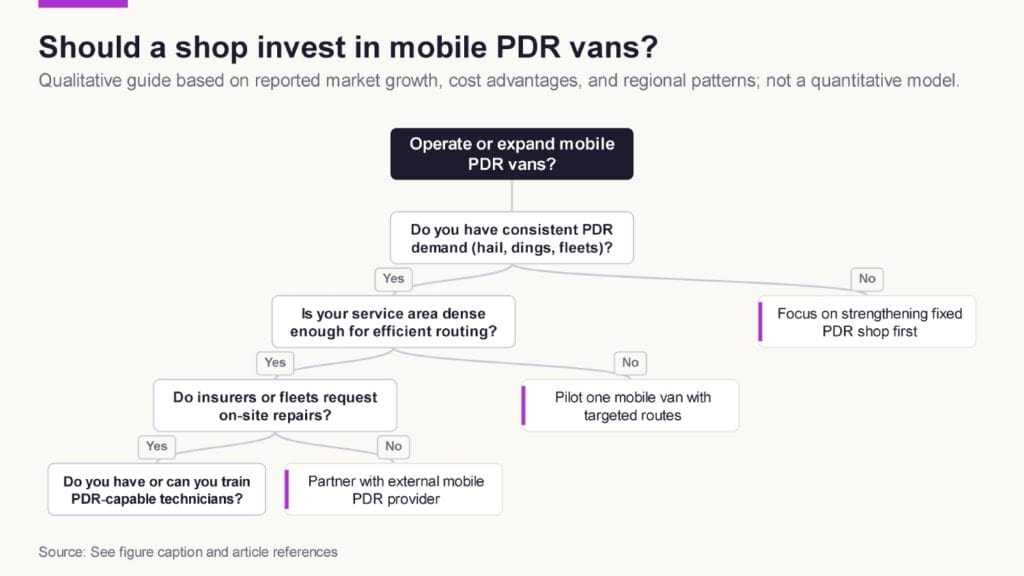
A decision tree guides repair operators through key questions—volume, geography, insurer demand, and staffing—to decide whether and how to expand into mobile PDR. Method: Branch logic inferred from market evidence on where mobile PDR delivers the strongest economic and customer‑experience benefits, such as dense urban or hail‑exposed regions with insurer support.
For regional shops, expand the route before the fleet
Expand the route before expanding the fleet. For a regional shop, the practical question is whether nearby customers can sustain another technician’s productive day.
The mobile PDR forecast suggests broader opportunity, but its North American estimates cannot establish Treasure Valley demand. They reveal neither local bookings nor customer willingness to pay. Those uncertainties require local testing, not extrapolation from continental revenue.
The supplied narrative describes Gem State Dent Repair as combining a Garden City facility with Treasure Valley mobile service. No company-specific source or performance data independently verifies that description here. It can illustrate the proposed hybrid model, but cannot demonstrate that another van would succeed.
A regional test should narrow the service promise before widening coverage:
- Define a manageable area. Trial a compact Treasure Valley cluster with designated appointment days and clear travel boundaries.
- Validate commercial interest. Ask dealers and fleets about suitable vehicles, frequency, access, and approvals. Treat interest as a lead, not committed volume.
- Review repeatable performance. Assess completed work, travel, cancellations, rejected jobs, and earnings after costs. Separate ordinary demand from temporary surges.
Preserve the shop’s role where it adds value. Appropriate complex PDR, quality checks, and training may benefit from fixed facilities. Damage outside PDR’s scope requires another repair method, including referral when necessary.
The expansion decision should follow demonstrated demand that existing capacity cannot serve economically. Scattered appointments may require tighter scheduling rather than another vehicle. Unsuitable inquiries may require better screening rather than more capacity.
Should your shop add another van? Only when local demand, repair suitability, and operating results support it. For Treasure Valley operators, better routing or stronger partnerships may be the next investment—before another set of keys.
Limitations
- The supplied evidence summarizes commercial market reports. Their underlying datasets, methods, and full source text were not available for independent verification.
- Market definitions, base years, and forecast periods differ. The estimates cannot reliably establish mobile PDR’s share of total PDR or demonstrate share gains.
- Reported cost and downtime savings compare PDR with traditional bodywork, not mobile PDR with fixed-shop PDR. Detailed repair-level comparisons and consumer surveys are unavailable.
- The evidence provides no Idaho demand study, verified company performance, or mobile-van operating costs. Routing, customer-mix, and investment recommendations are hypotheses for local testing.
References
- End User Analysis
- Car Body Repair Market Size, Share & Forecast Report 2025 to 2034 | Dataintelo
- Top Companies Analysis
- Automotive Paintless Dent Removal Tools Market – Global Strategic …
- Paintless Dent Repair Market Size, Share & Forecast Report 2025 to …
- Paintless Dent Repair Kits Market Research Report 2034
- Paintless Dent Repair Service Market Forecast to 2031
- Global Paintless Dent Repair PDR Service Market Research Report …
- Mobile Paintless Dent Repair Services Market Size & Forecast 2033
- PDR Tools Market Research Report 2033 – Dataintelo
About The Author