
Can Every Motorcycle Dent Be Fixed With PDR? 7 Factors Technicians Check First
Many motorcycle dents and dings on tanks and fenders can be repaired without sanding, filler, or repainting. An experienced PDR technician assesses the metal, paint, access, and damage severity to determine whether motorcycle dent repair, gas tank dent repair, tank repair, or fender repair is suitable. Paintless Dent Repair helps preserve the original factory paint and finish, making it a valuable option for riders and collectors who want to maintain their motorcycle’s appearance and value.
For a deeper service overview, see Motorcycle Dent Repair , especially if you are comparing paintless dent removal with conventional body shop repair.
Factor #1: Dent Location on the Motorcycle Tank or Fender
Dent location is a key factor in motorcycle dent repair, as shallow dents on wider tank surfaces are often easier to restore than deep damage near sharp curves, body lines, filler openings, mounting points, or welded seams. Motorcycle gas tank dent repair also depends on the tank’s shape and metal structure, while complex curves and compound surfaces can make the motorcycle PDR process more precise and time-consuming.
Tank curves, seams, and body lines
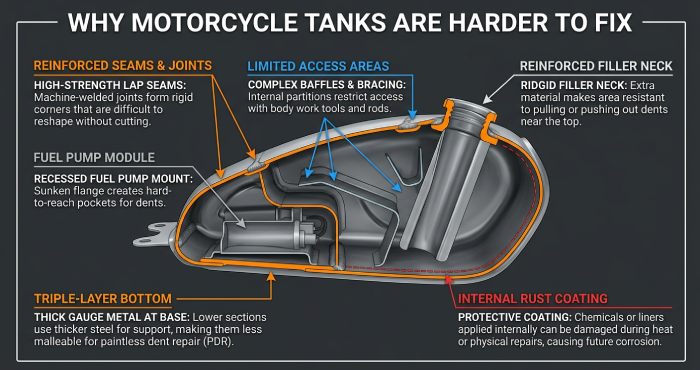
Motorcycle tank repair can be more challenging than car dent repair because rounded, reinforced tanks often provide limited access behind the damage. Motorcycle tank dent removal may require working around openings and internal components, and some tanks may need partial disassembly for proper access. Paintless dent removal is most effective when the metal and factory paint remain workable, while sharp creases, stretched areas, and deep crowns require greater precision to avoid overcorrection.
Fender position and mounting style
Motorcycle fender dent repair depends on the fender’s design, mounting position, and access behind the damaged area. Braces, wiring, lights, struts, rolled edges, and mounting holes can make metal fender repair more challenging, while dings and dents from road debris, storage bumps, or minor tip-overs are often good candidates for paintless dent repair when the metal and paint remain workable.
Factor #2: Depth and Sharpness of the Dent
The second factor is how deep, sharp, or stretched the damage is. Paintless dent repair is not simply “popping out” a dent. It is controlled metal movement using specialized tools, reflection tools, and years of panel work experience.
A shallow minor dent or small dent is usually a strong candidate for paintless dent removal. A deep dent with a sharp center point may still be repairable, but it requires more time, patience, and precision.
Soft dents versus sharp dents
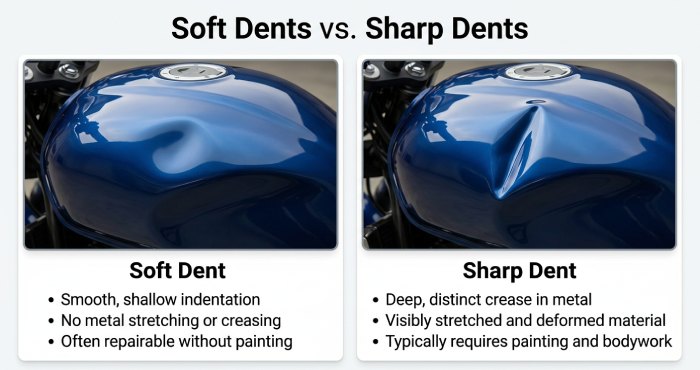
Soft dings from minor bumps or light impacts are often good candidates for motorcycle dent repair. Sharp dents with stretched metal require more precise techniques to restore the tank or fender while protecting the factory finish.
When metal stretch changes the repair plan
Severe metal stretching can limit how completely paintless dent repair can restore a motorcycle panel. In such cases, the technician may recommend partial correction or traditional motorcycle tank repair.
Factor #3: Whether the Paint Is Cracked, Chipped, or Stretched
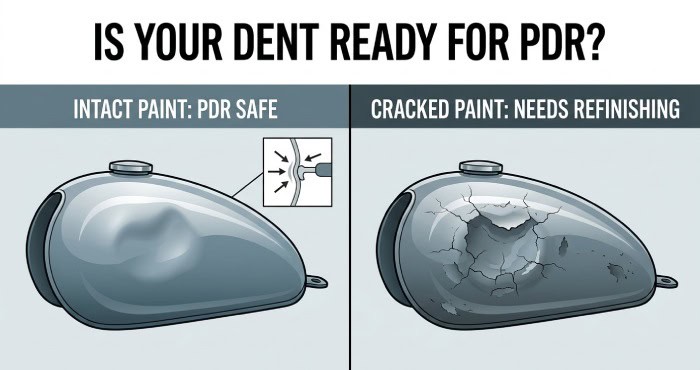
The condition of the paint is critical. Paintless dent removal is designed to preserve factory paint, not replace damaged paint. If the factory paint is intact, flexible, and bonded well to the metal, the chances of a successful motorcycle dent repair are much higher.
If there is cracked paint, chipped paint, or clear coat failure, the technician must be careful. PDR can still sometimes improve the shape, but it cannot restore missing paint.
Why factory paint matters
Factory paint is usually durable and well bonded, making paint preservation a key benefit of paintless dent repair. This process avoids filler, sanding, and repainting while providing an efficient alternative to traditional body repair.
When damaged paint limits PDR
Cracked or peeling paint can make paintless dent repair unsuitable for deep motorcycle dents. A skilled PDR technician can assess the damage and recommend either safe dent removal or traditional refinishing.
Factor #4: Metal Type and Panel Thickness
Motorcycle tanks and fenders vary in metal type and thickness, which affects how easily they can be repaired. Steel typically responds well to paintless dent repair, while aluminum may require specialized tools, greater experience, and slower, more controlled shaping.
Steel tank and aluminum tank behavior
Steel tanks can often be carefully worked back into shape, while aluminum may require greater precision because it can work-harden more quickly. Tank thickness also affects the repair approach, so technicians assess the metal, dent severity, and access before determining the best repair method.
Factor #5: Access Behind the Damaged Area
Paintless dent removal depends heavily on access behind the damaged panel or the ability to use controlled glue pulling. On motorcycle gas tanks, access may require the filler neck, petcock opening, or fuel sending unit port. In some cases, the tank must be removed and properly prepared before motorcycle gas tank dent repair begins.
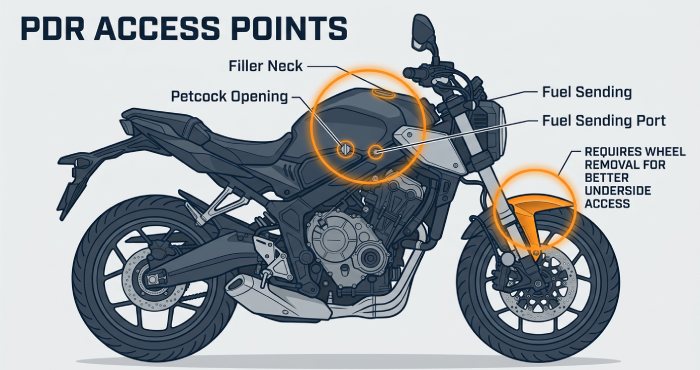
Fender access can be limited by tires, braces, lights, mounting hardware, and frame components. Motorcycle fender dent repair may require partial disassembly or wheel removal. Proper lighting and reflection tools help technicians identify the dent accurately and restore the panel while preserving the factory paint.
Factor #6: Previous Repairs, Filler, or Repainted Surfaces
Previous repairs can affect the success of paintless dent repair. Factory-painted panels are generally the best candidates, while body filler, repainting, sanding, or other repair materials can increase the risk of cracking or paint separation during motorcycle tank repair.
A repainted tank or fender should be carefully inspected before work begins. Technicians may need to adjust their repair method based on paint adhesion and panel condition. A professional assessment helps determine whether motorcycle gas tank dent repair or motorcycle fender dent repair can be completed safely.
Factor #7: Overall Repairability and Whether PDR Is the Right choice
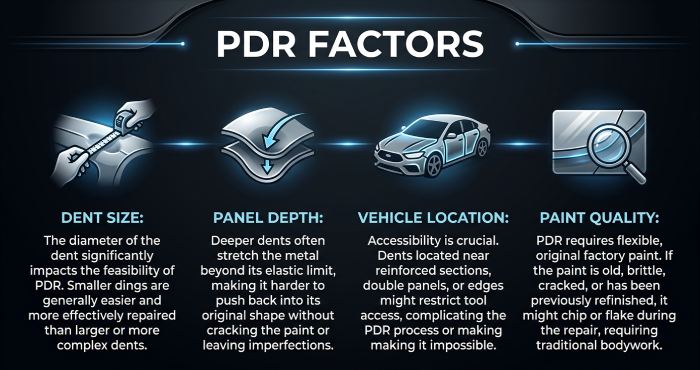
The cost and repair time depend on the dent’s size, depth, location, metal condition, paint quality, access, and any disassembly required. A small dent in an accessible fender may be repaired relatively quickly, while a deep crease or difficult-to-access tank dent may require more time and specialised techniques.
Paintless dent repair can be an excellent option when the original paint is intact and preserving the factory finish is important. However, conventional repair may be more appropriate when the damage involves cracked paint, torn or severely stretched metal, rust, extensive filler, or areas that cannot be safely accessed. A professional inspection can help determine which repair method is most suitable for restoring the motorcycle’s appearance.
About The Author