
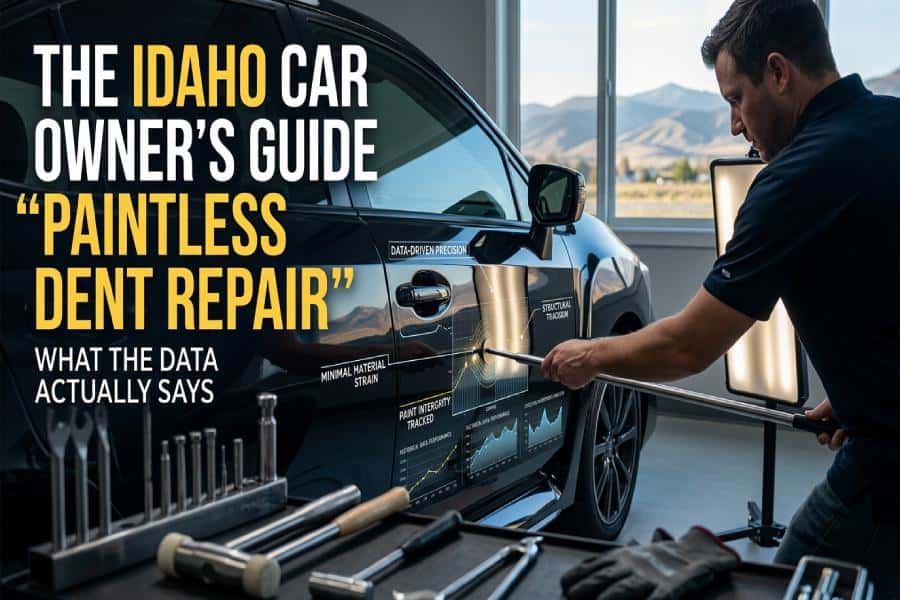
“How a $4.5 billion industry can save Idaho drivers thousands — and why most people have never heard of it.“
A shopping cart in the Boise Fred Meyer parking lot. A stray hailstone from a summer thunderstorm rolling down the Treasure Valley. A car door flung open a little too wide at the Eagle Island trailhead. If you drive in Idaho, dents happen.
The question is never if your car will pick up a ding. It’s what you’ll do about it when it does — and whether the repair method you choose will cost you $150 or $1,500, take two hours or two weeks, and preserve your car’s value or quietly destroy it.
That’s where paintless dent repair enters the conversation. PDR is a technique where trained technicians use specialized tools to massage dented metal back into its original shape from behind the panel — no sanding, no body filler, no repainting. The process has been around for decades in the auto manufacturing world, but most Idaho car owners still don’t know it exists as a consumer service. And the data suggests they’re paying for that knowledge gap.
This guide is built on data, not sales pitches. Every claim in it is sourced from industry white papers, government hazard reports, insurance company documents, and market research — the kind of information buried in PDFs and institutional databases that most blogs never surface. By the end, you’ll know exactly when PDR makes sense, what it should cost, how it interacts with your Idaho insurance, and what the research says about its impact on your car’s value.
A $4.5 Billion Industry Most Car Owners Don’t Know About
Let’s start with scale. The global paintless dent repair service market is valued at approximately $4.5 billion in 2025 and is projected to reach $6.8 billion by 2032, growing at a compound annual growth rate of 6.3%, according to a 2025 market expansion report published through OpenPR. Separately, the tools market alone — just the rods, glue pullers, and lighting equipment technicians use — was valued at $1.23 billion in 2026 and is forecast to reach $2.09 billion by 2032 at a 9.19% CAGR, per Research and Markets.
What this means for you: This isn’t a niche side hustle. PDR is a maturing, well-funded global industry backed by major insurers, OEM dealerships, and institutional investment. When you take your car to a certified PDR technician in Boise or Idaho Falls, you’re accessing the same professional repair ecosystem used by dealerships, fleet managers, and insurance carriers nationwide. The industry’s growth rate also tells you something important — demand is accelerating, which means more technicians are entering the Idaho market and competition is driving quality up.
KEY TAKEAWAY: PDR is not a workaround or a budget shortcut. It’s the preferred repair method for the majority of minor dent damage, backed by a $4.5 billion global industry growing at 6.3% annually.
The 80–90% Statistic That Changes Everything
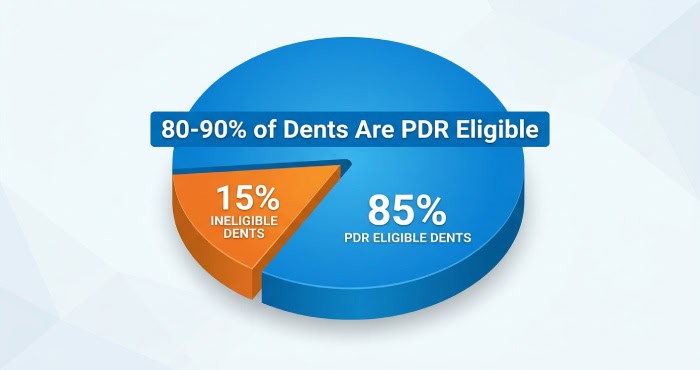
Here is the single most important number in this entire article: according to AAA, an estimated 80% to 90% of minor dents and dings can be repaired using paintless dent repair. This figure is cited in a Mitchell International white paper on PDR trends, published through Enlyte, and it has become the benchmark reference across the collision repair industry.
Think about what that means practically. For every ten dents your car accumulates over its lifetime — door dings in the Costco lot, hail pocks from an afternoon storm near Twin Falls, a basketball that bounced wrong in the driveway — eight or nine of them can likely be removed without touching your paint, without body filler, and without your car sitting in a shop for days.
What makes a dent eligible for PDR? The paint must be intact (no cracks, chips, or flaking), the metal cannot be severely stretched or creased, and the technician needs physical access to the back side of the panel. Dents up to approximately four inches in diameter with a shallow profile are typically ideal candidates. Dents that cross a body line — the raised contour running along a door or fender — are repairable but involve stiffer metal, which is why technical analyses from Engineer Fix report that body line dents often carry a 25% or greater surcharge. Aluminum panels (increasingly common on trucks and SUVs) can add another 20–50% to the cost because aluminum lacks the elastic memory of steel and is harder to manipulate.
When PDR is not an option: Deep dents where the metal has stretched thin, damage where the paint has cracked or chipped, areas with previous body filler from past conventional repairs, and severe collision damage that affects structural components all exceed PDR’s scope. In these cases, traditional body shop repair — with its sanding, filling, and repainting process — remains necessary.
Your PDR Eligibility Quick Check
- Paint intact? No chips, cracks, or flaking at the dent site. If you can run your finger over the dent and the surface is smooth, that’s a good sign.
- Dent size reasonable? Generally under four inches in diameter. Larger dents may still qualify depending on depth and location.
- Shallow depth? Dents with a gentle curve rather than a sharp crease are the best candidates. Deep impacts that create a point or ridge are more challenging.
- Access available? The technician needs to reach behind the panel. Most doors, fenders, hoods, and roof areas are accessible. Some areas near structural pillars or double-layered panels are harder to reach.
- No prior body filler? If the panel was previously repaired with conventional methods, the rigid filler will crack when PDR tools try to move the metal.
YOUR NEXT STEP: If all five criteria above check out, your dent is very likely a PDR candidate. A reputable technician will give you a free assessment — and if they tell you PDR won’t work, a good one will explain exactly why and what alternatives you have.
What PDR Actually Costs — and How Much You Save
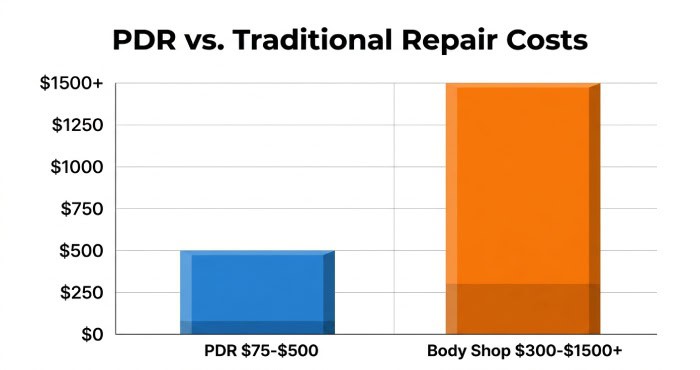
The cost data across multiple industry sources paints a consistent picture. Paintless dent repair typically costs between $75 and $500 or more per dent, depending on size, depth, location, and material. That compares to $300 to $1,500 or more per panel for traditional body shop work involving sanding, filler, and repainting, according to pricing data from L&M Car Detailing. Multiple sources converge on a savings range of 40–70% when PDR is used instead of conventional methods. Engineer Fix’s technical analysis narrows the labor savings specifically to 40–60%, while BodyGuard PDR reports savings as high as 65%. A Northwest-based PDR provider, Auto Dent-ist Inc., which has operated for over 26 years, quotes PDR at roughly one-quarter to one-half the rates of traditional body shops, starting as low as $99 for simple dings.
Let’s put real numbers to this. Say you have a typical door ding — maybe two inches across, fairly shallow, on the driver’s side door of your Subaru Outback (the unofficial car of Idaho). A traditional body shop would likely quote $400–$800 after sanding, filling, repainting, and blending color across adjacent panels. That same dent through PDR would typically run $125–$250, be finished in an hour or two, and leave your factory paint completely untouched. On a more complex scenario — say hail damage across three or four panels — you might be looking at $2,000–$4,000 from a body shop versus $800–$1,500 through PDR.
PDR vs. Traditional Repair: Side-by-Side Comparison
| Factor | Paintless Dent Repair | Traditional Body Shop |
| Cost per dent | $75–$500+ | $300–$1,500+ |
| Hail damage (full vehicle) | $800–$1,500 | $2,000–$5,000+ |
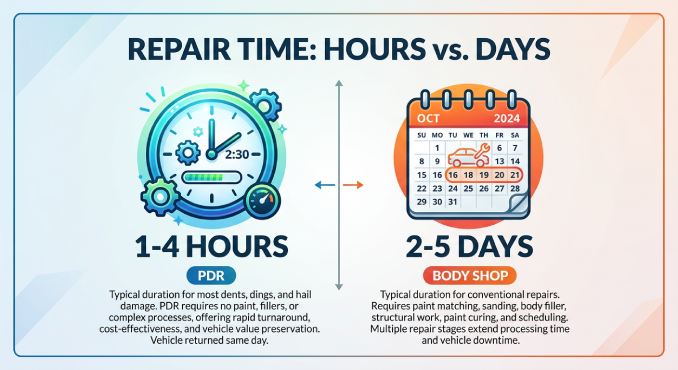
| Repair time | 1–4 hours (most jobs) | 2–5 days minimum |
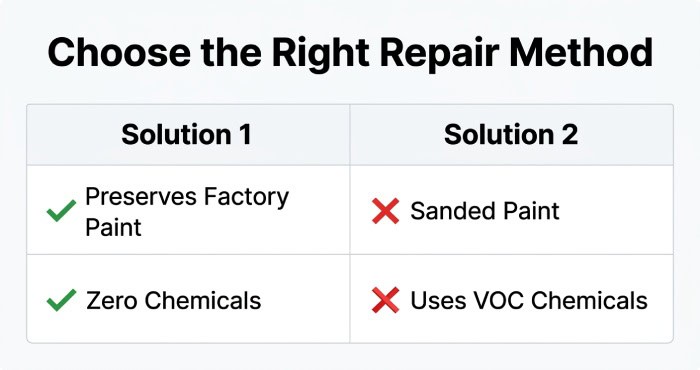
| Paint affected? | No — factory finish preserved | Yes — sanded and repainted |
| Chemicals used? | None — zero VOC emissions | Paint, primer, solvents (VOCs) |
| Carfax impact? | No report generated | Repaint may be recorded |
Sources: L&M Car Detailing pricing guide; Engineer Fix technical analysis; BodyGuard PDR cost report; Auto Dent-ist Inc. FAQ. See references section for full links.
THE REAL SAVINGS: The savings aren’t just at the register. PDR’s speed — hours instead of days — means you skip the rental car, skip the schedule disruption, and skip the risk of color mismatch from repainting. For most Idaho drivers, the real cost of a body shop repair includes all those hidden expenses on top of the quoted price.
Hail Damage in Idaho: What the Government Data Says About Your Risk
Idaho isn’t Texas or Colorado when it comes to hail, but dismissing the risk would be a mistake. According to Idaho’s official State Hazard Mitigation Plan (Chapter 3.3: Severe Storms), published by the Idaho Office of Emergency Management, “the entire State of Idaho is exposed to hail as a component of thunderstorm events.” The same document notes that hail causes $1 billion in damage to crops and property across the United States each year. While the plan characterizes Idaho as having “relatively low potential for significant hail events,” it also confirms that hailstorms can and do damage vehicles statewide.
At the county level, the data gets more specific. Ada County’s Severe Weather fact sheet — covering the Boise metro area, Idaho’s largest population center — reports an average of one to two severe thunderstorms per year. These aren’t abstract statistics: in August 2010, 70 people were treated for injuries when 65+ mph winds tore through the Western Idaho Fair, a storm that was accompanied by the kind of severe weather conditions that produce damaging hail.
Now look at the national hail numbers to understand scale. The Insurance Information Institute reports that NOAA documented 5,432 significant hail events in 2025 and 5,373 in 2024. State Farm alone paid out over $3.5 billion in hail claims in a single year (2022) — an increase of more than $1 billion from the prior year. The National Insurance Crime Bureau (NICB) analyzed 2,769,362 hail loss claims from 2017 to 2019 and found that personal auto accounted for 734,985 of those claims — roughly one in four. Perhaps most striking is a data point from a Texas legislative hearing document: hail claims represented 12% of all U.S. comprehensive vehicle claims in 2023, up from 6.8% in 2022 — nearly doubling in a single year.
What this means for Idaho drivers: You don’t need to live in Tornado Alley for hail to be a real financial risk. Idaho’s summer thunderstorm season — particularly from May through September across the Snake River Plain, Treasure Valley, and Magic Valley — regularly produces hail-capable storms. Even a “low probability” event only needs to happen once to leave your vehicle with dozens of dents. When it does, PDR is overwhelmingly the preferred repair method: it handles hail damage across multiple panels faster, cheaper, and without altering your paint. This is precisely why insurance companies actively prefer it.
CRITICAL FOR IDAHO DRIVERS: The average hail damage insurance claim runs $3,000–$4,000, with the average comprehensive deductible around $500, according to AutoInsurance.com. That means your out-of-pocket on a typical hail claim is $500, and your insurer covers the rest — but only if you carry comprehensive coverage, which in Idaho is optional. If you don’t have it and a storm hits, you’re paying the full bill yourself.
Idaho Insurance and PDR: What You Need to Know Before the Next Storm
Idaho requires minimum auto insurance of $25,000/$50,000 bodily injury and $15,000 property damage liability, according to the Idaho Department of Insurance (as referenced by American Family Insurance). Here is the critical detail that catches many Idaho drivers off guard: comprehensive coverage — the only coverage type that pays for hail damage — is completely optional in Idaho. There is no state requirement to carry it.
This creates a significant exposure gap. With nearly two million registered vehicles in Idaho and SUVs making up 41% of the fleet (followed by trucks at 29%), there are a lot of large, exposed vehicle surfaces driving around without hail coverage. If you’re one of them and a summer thunderstorm drops golf-ball hail on your Ford F-150 while it’s parked outside your Meridian office, you’re looking at thousands of dollars in repairs with no insurance to fall back on.
Practical Steps to Take Right Now
1. Check your policy today. Look at your declarations page or call your agent. Confirm whether you carry comprehensive coverage. If you do, note your deductible amount — the average is about $500, but yours may be higher or lower.
2. If you don’t have comprehensive, consider adding it. The cost is typically modest — Idaho’s auto insurance rates are among the lower ones nationally, with full coverage averaging around $1,402 per year according to Idaho Vehicle Portal data. Comprehensive is a fraction of that.
3. Know that insurers prefer PDR for hail claims. As BodyGuard PDR explains, insurance companies actively recommend paintless dent repair for qualifying hail damage because it’s faster and cheaper. When you file a hail claim, ask your adjuster specifically about PDR as an option.
4. Understand the deductible math. If your deductible is $500 and the repair estimate is $600, filing a claim nets you only $100 — and it goes on your record. For minor damage close to your deductible, paying out of pocket for PDR ($75–$250 for small dents) may be the smarter financial move.
5. Don’t wait. Unrepaired hail dents expose bare areas to moisture, which can lead to rust. Idaho’s freeze-thaw cycles make this worse. Address dents promptly to avoid compounding damage.
The Resale Value Equation: Why Unrepaired Dents Cost More Than You Think
Most Idaho car owners think of dents as cosmetic annoyances. The data says they’re financial liabilities. According to estimates attributed to Kelley Blue Book and cited by National Dent Repair’s resale value analysis, cosmetic damage like minor dents and scratches can reduce a vehicle’s resale value by 10–15% depending on severity and location. On a vehicle worth $30,000 — about what a well-equipped Toyota Tacoma or Subaru Ascent runs in Idaho — that’s $3,000 to $4,500 in lost value from dents you might have been ignoring.
The same analysis cites Carfax data indicating that vehicles with non-original paint or body filler can lose up to 20% more value than those with factory finishes. This is where the distinction between PDR and traditional repair becomes financially critical. When a body shop sands, fills, and repaints a panel, that repaint may be recorded in the vehicle’s history. Even if the color match is perfect, the signal it sends to a buyer is: this car was damaged badly enough to need repainting. PDR avoids this entirely. Because the factory paint is never touched, there’s nothing to report, nothing for a buyer to question, and no depreciation penalty.
The practical takeaway: If you’re planning to sell or trade in your vehicle within the next few years, investing $150–$300 in PDR for a few door dings can return $500–$1,000 or more in preserved resale value. One case study cited by National Dent Repair described a driver who spent $300 on PDR before trading in their vehicle and received an offer $700 higher than the dealership’s initial assessment of the dented car. That’s a better return than most investments.
VALUE PROTECTION: PDR doesn’t just fix your car — it protects your equity in it. Factory paint, no Carfax flags, no body filler, no color mismatch risk. For Idaho drivers who depend on trucks and SUVs that hold strong resale value, this distinction is worth thousands.
The Environmental Angle: Why PDR Is the Greener Choice
For a state where people genuinely care about their natural surroundings — from the Sawtooths to the Snake River — the environmental case for PDR is straightforward. Traditional body shop repair involves sanding, priming, painting, and clear-coating, all of which release volatile organic compounds (VOCs) into the atmosphere. The EPA regulates VOC emissions from auto body shops specifically because the impact is significant. As Rocky Mountain Dent Service details in their environmental analysis, a single vehicle repaint can release several pounds of VOCs. Multiply that across millions of repairs nationally, and auto body painting becomes a meaningful contributor to air pollution and ground-level ozone formation.
PDR produces zero VOC emissions. No paint, no primer, no solvents, no chemical waste. The only materials involved are the steel or aluminum tools the technician uses. As DentWerksPro notes, PDR techniques also take one-quarter to one-third the time of conventional methods. Less shop time means lower energy consumption, fewer resources used, and — because many PDR technicians are mobile — no need for energy-intensive spray booths, drying lamps, or ventilation systems.
There’s also a second-order environmental benefit. By making repairs affordable and accessible, PDR reduces the number of vehicles that get totaled or scrapped over cosmetic damage. When repair costs approach a vehicle’s value, insurers declare a total loss. PDR’s lower cost keeps more cars on the road longer, reducing the demand for new vehicle manufacturing — and all the materials, energy, and emissions that come with it.
How to Find a Qualified PDR Technician in Idaho
Not all dent repair is created equal, and this is an area where Idaho consumers need to be discerning. According to a 2025 market report from 360iResearch, skilled technician shortages are a recognized industry challenge. The specialized nature of PDR — which requires years of hands-on training to master — means the quality difference between an experienced technician and a novice can be enormous. A 2021 announcement from Mitchell International noted that the Vale PDR Technician Certification Program was responsible for certifying nearly 30,000 technicians nationwide — but that still leaves a gap between certified professionals and untrained operators.
What to Look for When Choosing a PDR Provider
- Certification. Ask whether the technician is Vale-certified, NAPDRT (National Alliance of Paintless Dent Repair Technicians) certified, or has equivalent credentials. Certification means they’ve been tested and trained to industry standards.
- Experience. Look for a minimum of 3–5 years of dedicated PDR work. This is a craft that improves dramatically with practice. Ask to see before-and-after photos of their work.
- Insurance relationships. Established PDR providers work regularly with major insurers. Ask if they work with your insurance company and can help with the claims process.
- Transparent pricing. A reputable technician will assess your damage, explain what can and can’t be fixed with PDR, and give you a clear quote before starting work. Be cautious of anyone who quotes without seeing the vehicle.
- Mobile vs. shop-based. Many Idaho PDR technicians are mobile, meaning they come to your home or office. This is a legitimate and convenient service model — not a red flag. Just confirm they’re insured and certified.
- Honest about limitations. The best technicians will tell you when a dent isn’t a good PDR candidate. If someone claims they can fix anything with PDR, that’s a warning sign.
Inside the Insurance Pricing: What State Farm’s PDR Matrix Reveals
Most consumers never see the pricing frameworks that insurance companies use to pay for PDR repairs. But State Farm’s Paintless Dent Repair Pricing Matrix is publicly accessible as a PDF, and it offers a rare window into how the nation’s largest auto insurer structures PDR payments. Understanding this document gives you leverage when working with your insurer or PDR provider.
Key details from the matrix: corrosion protection is billed at $10 per panel, up to a $30 maximum per vehicle. Dents are categorized by size relative to a half-dollar coin, with dents exceeding that size entered as $50 per dent. Aluminum panels carry a 25% markup over standard steel pricing. High-strength steel panels also carry a 25% surcharge. Double-layered panels and areas with limited access points may warrant additional markups. When the dent count exceeds the matrix’s thresholds, the repair can be negotiated on a case-by-case basis between the insurer and the repair facility.
Why this matters to you: If you drive a truck or SUV with aluminum body panels (like a Ford F-150, which is the best-selling vehicle in Idaho), you should expect PDR to cost more than it would on a steel-bodied sedan. The 25% aluminum surcharge is standard across the industry. Knowing this upfront helps you evaluate quotes and understand your insurance payout. It also means that if a PDR technician quotes you a higher price for your aluminum-bodied vehicle, they’re not overcharging — they’re reflecting the real difficulty of working with that material.
The Bottom Line for Idaho Car Owners
The data tells a clear story. Paintless dent repair is not a budget alternative to “real” repair. It is, for the vast majority of minor dent damage, the superior repair method — faster, cheaper, environmentally cleaner, and better for your car’s long-term value. The numbers back this up at every level:
- 80–90% of dents are PDR candidates (AAA / Mitchell International).
- 40–70% cost savings over traditional body shop repair (multiple industry sources).
- 10–15% resale value loss from unrepaired cosmetic damage (Kelley Blue Book).
- Up to 20% additional value loss from non-original paint (Carfax).
- Zero VOC emissions compared to several pounds per repaint (Rocky Mountain Dent Service / EPA).
- $3,000–$4,000 average hail claim, with $500 average deductible (AutoInsurance.com).
- Nearly 2 million registered vehicles in Idaho, with comprehensive hail coverage optional (Idaho DOI).
If you drive in Idaho, here is your action plan: verify that you carry comprehensive coverage before hail season hits. Get a free PDR assessment for any existing dents — even small ones — because the resale value math almost always favors repair. Choose a certified, experienced technician. And if a storm does catch your car in the open, know that PDR can restore it without the cost, delay, or paint compromise of a body shop visit.
Your car picks up dents in Idaho. That part is inevitable. What isn’t inevitable is overpaying to fix them.
References and Sources
All sources cited in this article are listed below with full URLs. Every link was verified at the time of publication.
Government and Institutional Sources
Idaho Office of Emergency Management, State Hazard Mitigation Plan, Chapter 3.3: Severe Storms
https://ioem.idaho.gov/wp-content/uploads/2018/12/ID-SHMP-Chapter-3.3-Severe-Weather.pdf
Ada County Emergency Management, Severe Weather Fact Sheet
https://adacounty.id.gov/emergencymanagement/wp-content/uploads/sites/39/Severe_Weather.pdf
Idaho Vehicle Portal / Idaho Transportation Department, Vehicle Registration Data
Idaho Department of Insurance, Required Auto Coverage (via American Family Insurance)
https://www.amfam.com/insurance/car/coverages-by-state/idaho
Insurance Information Institute, Facts + Statistics: Hail
https://www.iii.org/fact-statistic/facts-statistics-hail
National Insurance Crime Bureau (NICB), Top 5 States for Hail Claims 2017–2019
https://www.nicb.org/news/news-releases/top-5-states-hail-claims-2017-2019-data
Texas Casualty Insurance Association, Legislative Hearing Handout on Hail and Auto Insurance
Industry White Papers and Market Reports
Mitchell International / Enlyte, Trends in Paintless Dent Repair (White Paper)
https://www.enlyte.com/insights/article/auto-physical-damage/trends-paintless-dent-repair
Research and Markets, Automotive Paintless Dent Removal Tools Market Size and Trends Report
https://www.researchandmarkets.com/report/paintless-dent-removal
Technavio, Automotive Paintless Dent Removal Tools Market Analysis and Forecast
https://www.technavio.com/report/automotive-paintless-dent-removal-tools-market-industry-analysis
360iResearch, Paintless Dent Repair Service Market Size and Share Report
https://www.360iresearch.com/library/intelligence/paintless-dent-repair-service
WMR / OpenPR, Paintless Dent Repair (PDR) Service Market Expansion Report 2025–2032
https://www.openpr.com/news/4220424/paintless-dent-repair-pdr-service-market-set-for-rapid
Insurance and Pricing Sources
State Farm, Paintless Dent Repair Pricing Matrix (PDF)
AutoInsurance.com, Hail Coverage and Claims Guide
https://www.autoinsurance.com/coverage/hail
Industry and Technical Sources
Mitchell International, Vale PDR Technician Certification Program Announcement
Engineer Fix, How Much Does Paintless Dent Repair Cost? (Technical Analysis)
https://engineerfix.com/how-much-does-paintless-dent-repair-cost/
L&M Car Detailing, PDR Pricing Guide
https://www.lmcardetailing.com/how-much-is-paintless-dent-repair
BodyGuard PDR, How Paintless Dent Repair Saves You Money in the Long Run
https://www.bodyguardpdr.com/how-paintless-dent-repair-saves-you-money-in-the-long-run
National Dent Repair, How Paintless Dent Repair Preserves Your Car’s Resale Value
https://ndrtn.com/how-paintless-dent-repair-preserves-your-cars-resale-value/